Steel Castings for the Automotive Sector: Meeting Strength, Safety & Scale Requirements

Automotive components live a demanding life. They absorb road shock, cycle through heat and cold, carry structural loads for years without failure, and in almost every case have to do it while meeting strict safety certifications and tight cost targets. For OEMs and Tier 1 suppliers sourcing cast components, steel casting sits at the intersection of three requirements that don’t always play well together: strength, safety, and scale.

At Austin Alloy Cast, we supply investment cast steel components into engineering and heavy duty applications where failure isn’t an option and volume isn’t negotiable. Here’s what automotive sourcing and design teams should understand about steel castings before locking in supplier decisions.

Why Steel Castings Still Matter in Automotive Manufacturing

Despite the industry’s ongoing shift toward lightweighting alternatives, steel castings remain essential wherever a component needs high strength to cost ratio, wear resistance, or the ability to survive repeated stress cycles. Steering knuckles, differential housings, suspension components, brake system parts, and various drivetrain elements are frequently cast in steel precisely because the material delivers predictable mechanical performance under real world abuse potholes, temperature extremes, and years of vibration.

Investment casting, in particular, allows automotive parts to be produced near net shape with complex geometries that would otherwise require extensive machining or multi part assemblies. That translates into fewer joints, fewer failure points, and often a lighter, more efficient part than a fabricated equivalent.

Strength: Designing for Real World Loads, Not Just Spec Sheets

Automotive components rarely fail under a single overload event; they fail from fatigue, accumulated over thousands of load cycles. This makes fatigue strength, not just tensile strength, one of the most important properties to specify correctly.

A few factors that influence real world strength performance:

  • Grain structure and porosity control. Even minor internal porosity can become a crack initiation point under cyclic loading. Casting process control matters as much as alloy selection.
  • Alloy selection matched to duty cycle. A part that sees constant vibration and shock loading, like a suspension component, needs different toughness characteristics than a static bracket.
  • Heat treatment consistency. Mechanical properties promised on a data sheet are only realized if heat treatment is controlled and repeatable across every batch, not just the first sample lot.

OEMs should push suppliers for process documentation, not just certified test results on isolated samples, batch to batch consistency is what actually protects a vehicle program from field issues.

Safety: Where Casting Quality Becomes Non-Negotiable

Automotive castings frequently go into safety critical systems steering, braking, suspension where a hidden defect can have consequences far beyond a warranty claim. This is where casting quality assurance stops being a formality and becomes core to the sourcing decision.

Key quality checkpoints that matter for automotive grade steel castings include:

  • Non-destructive testing such as radiography, dye penetrant, or magnetic particle inspection to catch internal or surface defects before parts ship.
  • Dimensional verification against CAD models, especially for parts that mate with other precision components.
  • Material traceability, so every casting can be traced back to its raw material heat and process batch if an issue ever surfaces in the field.
  • Certification to recognized standards, giving OEMs documented assurance that the casting process itself is controlled and auditable.

Automotive sourcing teams should treat a supplier’s quality system, not just their price quote, as a primary qualifying factor, particularly for any part with safety or regulatory implications.

Scale: Producing Consistently, Not Just Once

A prototype casting proving a design works is only half the challenge. Automotive programs need suppliers who can reproduce that same quality across production volumes that may run into the tens of thousands of units annually, without drift in dimensional accuracy or mechanical properties.

Scaling steel casting production reliably depends on:

  • Tooling design built for repeatability, not just first article approval.
  • Process capability, meaning a facility that can hold tight tolerances consistently across long production runs, not just under ideal single piece conditions.
  • Capacity planning, since automotive programs often need volume flexibility as vehicle demand shifts.
  • Value added machining and finishing integrated into the supply chain, reducing the number of external touchpoints between casting and finished parts.

This is also where facility scale genuinely matters. A foundry that can handle heavier per piece weights and larger production volumes at a single location reduces the coordination risk that comes from splitting production across multiple smaller suppliers.

What This Means for Design and Sourcing Teams

Before finalizing a cast steel component for an automotive program, it’s worth working through a short set of questions with your casting partner:

  • What is the actual fatigue and load profile the part will see in service, not just its static strength rating?
  • What non-destructive testing and traceability does the supplier apply as standard, versus what’s optional?
  • Can the supplier demonstrate consistency across production volume batches, not just prototype samples?
  • Are machining and secondary processes handled in house or through additional vendors, and how does that affect lead time and quality control?
  • Does the casting facility have proven capacity to scale with the program’s volume over its lifecycle?

Getting these answers early during design and supplier qualification prevents costly surprises once a part is locked into a vehicle program and production is running at full volume.

Partnering for the Long Run

Automotive steel castings sit under real pressure: they need to perform reliably for years, meet exacting safety expectations, and be producible at volume without variation. That combination rewards suppliers who treat process control, testing, and scalability as fundamentals rather than added extras.

At Austin Alloy Cast, we work with automotive and general engineering clients on investment cast steel components engineered for exactly this kind of demanding service from initial prototype through full production scale. If your program is evaluating cast component suppliers, it’s worth a technical discussion before designs are finalized.
Carbon Steel vs Alloy Steel Castings: What OEMs Should Know Before Finalizing Designs

For OEMs designing components that will spend years under load, heat, pressure, or corrosive exposure, the choice between carbon steel and alloy steel castings is rarely just a spec sheet decision. It shapes tooling costs, lead times, machining behavior, and most importantly how the part performs once it leaves the drawing board and enters the field. Getting this call right early saves rework, redesigns, and expensive field failures later.

At Austin Alloy Cast, we work with design and procurement teams across valve and pump, oil and gas, mining, marine, and heavy equipment industries who are weighing exactly this trade off. Here’s a practical breakdown of what actually separates the two, and how to think through the decision before a design gets locked in.

The Core Difference

Carbon steel castings derive their properties primarily from carbon content, with minimal additional alloying elements. They’re straightforward, cost effective, and well understood, a dependable choice when the application doesn’t demand exceptional resistance to heat, corrosion, or wear.

Alloy steel castings, on the other hand, are engineered with deliberate additions, chromium, nickel, molybdenum, manganese, vanadium, and others to achieve specific mechanical or environmental performance. These additions change how the metal behaves under stress, temperature swings, and chemical exposure, often at a higher material and processing cost.

Neither is inherently “better.” The right choice depends entirely on what the part needs to survive.

Where Carbon Steel Makes Sense

Carbon steel castings are a strong fit when:

  • The operating environment is relatively gentle, no aggressive chemicals, minimal thermal cycling, moderate loads.
  • Cost control and shorter lead times matter more than marginal performance gains.
  • The part will be coated, painted, or otherwise protected from corrosion externally.
  • Machinability and weldability are priorities, since carbon steel generally machines and welds more predictably than higher alloy grades.

Structural brackets, housings, general engineering components, and parts operating in controlled indoor environments often fall into this category. If an OEM is producing high volumes of a component that doesn’t face harsh service conditions, carbon steel usually delivers the best balance of performance and cost.

Where Alloy Steel Earns Its Premium

Alloy steel castings justify their added cost when the part faces one or more of the following:

  • High temperature service — alloys with chromium and molybdenum resist softening and scaling at elevated temperatures far better than plain carbon steel.
  • Corrosive or wet environments — oil and gas wellheads, marine hardware, and chemical processing equipment routinely need the corrosion resistance that alloying provides.
  • High wear or abrasive contact — mining, earth moving, and material handling components benefit from alloys engineered for hardness and toughness together.
  • Critical structural loads — where fatigue resistance and toughness at both high and low temperatures cannot be compromised.

For valve and pump bodies handling aggressive media, or earth moving components subject to constant abrasive wear, alloy steel isn’t a luxury; it’s what keeps the part from failing well before its expected service life.

Design Considerations OEMs Often Overlook

Section thickness and casting behavior. Alloy steels can behave differently during solidification than carbon steel, affecting shrinkage patterns and the likelihood of porosity in thicker sections. Designs should account for this early rather than adjusting after tooling is cut.

Machining allowances. Higher alloy grades often require different cutting parameters and tooling. If your part has tight tolerances or complex machined features, factor this into both cost estimates and lead time expectations.

Weldability for repairs or assembly. If the component will need field welding or repair down the line, some alloy grades require preheating and controlled cooling to avoid cracking, a maintenance consideration that’s easy to miss at the design stage.

Heat treatment requirements. Many alloy steel castings need post cast heat treatment to achieve their intended mechanical properties. This adds a process step and should be built into project timelines from the start, not discovered mid production.

Total cost of ownership, not just unit price. A carbon steel part that fails or corrodes within two years can cost far more in downtime, replacement, and warranty claims than a slightly pricier alloy steel casting that lasts the full service life. OEMs designing for harsh or critical applications should weigh lifecycle cost, not just quoted price per piece.

A Practical Way to Decide

Before finalizing a casting material, it helps to walk through a few direct questions:

  • What is the actual operating environment, temperature range, chemical exposure, load type?
  • What is the expected service life, and what does failure cost in downtime or safety terms?
  • Does the part require specific mechanical properties like impact toughness at low temperatures, or hardness for abrasion resistance?
  • What are the machining, welding, and heat treatment implications for each material option?
  • How do total lifecycle costs compare, not just initial casting price?

Answering these questions with real application data rather than defaulting to habit or the cheapest quoted option is what separates designs that perform reliably from those that need costly revisions after field deployment.

Getting It Right From the Start

Choosing between carbon steel and alloy steel castings isn’t just a materials question, it’s a design decision with downstream effects on manufacturability, cost, and long term reliability. The best outcomes happen when material selection is part of the conversation from the earliest design stages, not an afterthought once tooling is already underway.

At Austin Alloy Cast, we work alongside OEM engineering teams through the investment casting process from material selection and prototype development to full production to make sure the castings specified actually match the demands of the application. 

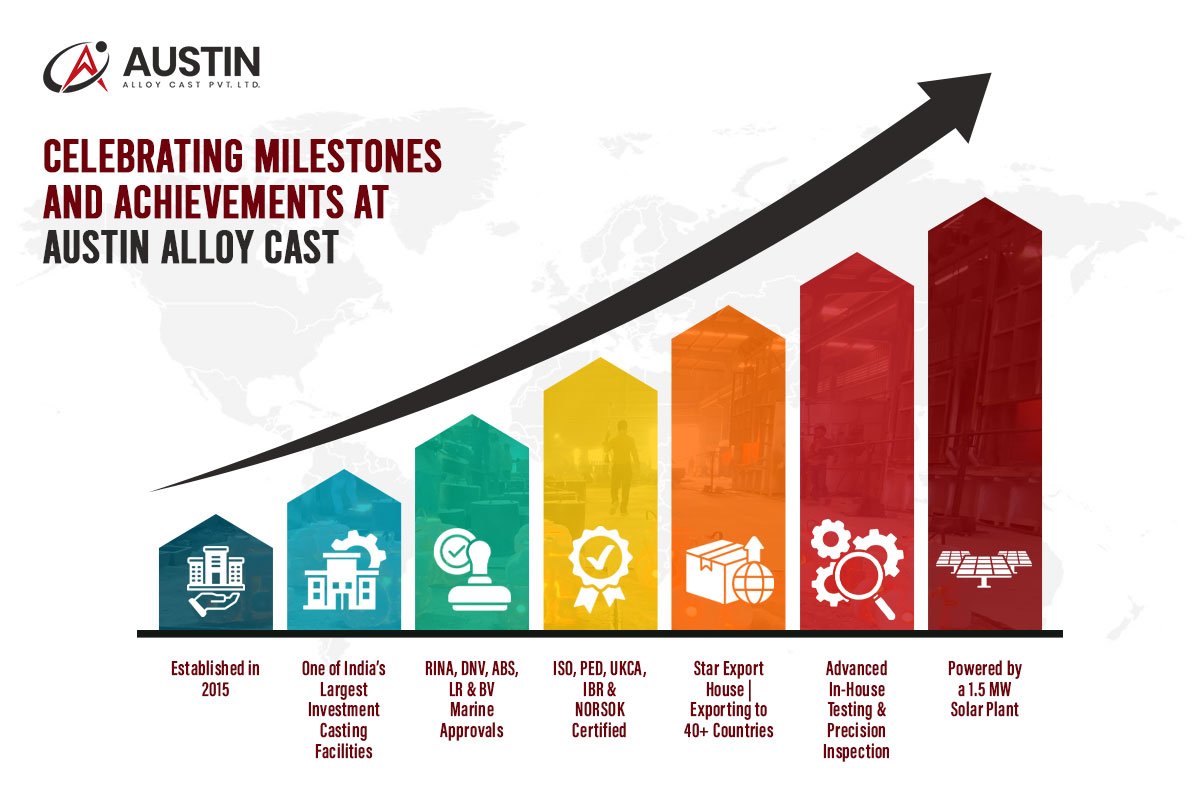
Celebrating Milestones and Achievements at Austin Alloy Cast

Every certification, facility expansion, and export approval a company earns is a marker of a decision made years earlier, usually the harder one, not the easier one. At Austin Alloy Cast, our milestones aren’t trophies on a shelf; they’re proof points of a strategy we’ve followed since our founding: build one large, fully integrated facility, invest in real testing infrastructure, and earn recognition the slow way, through audits and performance rather than claims. Here’s a look at where that strategy has taken us.

Building One of India’s Largest Single Location Investment Casting Facilities

Austin Alloy Cast was established in 2015, and from the outset, the plan wasn’t to grow through scattered, smaller units; it was to consolidate. Today, our facility sits on a total land area of 25,000 sq meters. That scale allows us to describe ourselves accurately as one of India’s largest investment casting facilities at a single location, with the capability to handle large production volumes without splitting orders across multiple sites.

A single location scale isn’t just a real estate statistic. It means wax injection, shell building, pouring, heat treatment, machining, and testing all happen under one roof, under one quality system which is a meaningful advantage for OEMs who want fewer handoffs and tighter control over their supply chain.

Earning RINA Marine Approval, A Rare Distinction in India

One of our most significant recent milestones is achieving RINA marine classification approval. This matters because RINA is one of the more demanding classification societies to satisfy, and Austin Alloy Cast is only the sixth foundry group in India to receive it. More notably, we are the only pure play investment casting company in the country to hold this accreditation.

That approval sits alongside marine approvals from DNV, ABS, Lloyd’s Register, and BV giving Austin Alloy Cast a marine certification profile that few Indian foundries, and fewer still pure investment casting specialists, can match. For OEMs supplying safety critical marine and offshore programs, that’s not a marketing claim; it’s a documented, audited capability.

A Full Certification Portfolio Built Over Time

Milestones in manufacturing rarely arrive all at once they’re earned certification by certification, audit by audit. Over time, Austin Alloy Cast has built a certification portfolio that includes ISO 9001:2015 for quality management, ISO 14001:2015 for environmental management, and ISO 45001:2018 for occupational health and safety. On the regulatory side, we hold PED 2014/68/EU and UKCA approvals for pressure equipment supplied into the EU and UK, along with Indian Boiler Regulations (IBR) compliance for the domestic boiler and pressure parts market.

For OEMs in oil and gas, we also hold NORSOK M-630 Ed. 6 approval of a standard specifically relevant to materials and manufacturing procedure specifications for demanding offshore conditions. Each of these was not pursued for the sake of a longer certificate list; each one opened access to a specific class of application our customers needed us to serve.

Recognized as a Star Export House by the Government of India

Austin Alloy Cast has been certified by the Government of India as a Star Export House, a recognition tied directly to sustained export performance. Through our group’s Emporia division, which operates a dedicated overseas sales office in Singapore, we export to more than 40 countries. That combination of a domestic manufacturing base built for scale, plus a genuinely global sales and service structure is part of what the Star Export House status reflects.

Investing in Testing Infrastructure, Not Just Claiming It

A milestone we’re particularly proud of is the depth of our in-house testing infrastructure, because it’s the part of the business that directly protects every other achievement. Austin Alloy Cast runs 100% dye penetrant testing and 100% magnetic particle testing on applicable components, in-house radiography using both Ir-192 and Co-60 sources in separate dedicated facilities, and ultrasonic testing capability. Our lab includes a spectrometer covering Fe and Ni based alloys across 35 elements, validated against certified reference material samples, and dimensional inspection via CMM.

Building this in house rather than outsourcing testing to third parties was a deliberate, capital intensive decision. It’s one of the milestones that doesn’t show up as a framed certificate on a wall, but it’s arguably the one that matters most to the OEMs who depend on us.

Growing as Part of a Diversified Manufacturing Group

Austin Alloy Cast operates within a broader group that includes Metflow (steel sand castings, incorporated 2006), Galaxy Technoforge (seamless rolled rings, hot forged profile rings, bearing races, and gear blanks, incorporated 2002), and Ayushi Engineering (machined components for automotive and general engineering, established 2003). Together, this gives customers access to investment casting, sand casting, seamless rolled rings, and precision machining all from group companies operating in Western India, rather than needing to qualify separate suppliers for each process.

We’re also proud members of the EICF (Engineering Investment Casting Foundries), reflecting our ongoing participation in the industry’s standards and community, not just our own internal targets.

Investing in Sustainability as a Core Milestone

Growth at Austin Alloy Cast hasn’t come at the expense of environmental responsibility. Our facility is partially powered in part by a 1.5 MW solar power plant, a deliberate investment in green energy that supports our ISO 14001 environmental management commitments and reflects a broader group philosophy of sustainable, reliable, and affordable energy use.

What These Milestones Mean Going Forward

None of these achievements, the facility scale, the RINA and marine approvals, the certification portfolio, the Star Export House status, or the in house testing capability were pursued in isolation. Each one exists because a customer, somewhere, needed Austin Alloy Cast to prove it could meet a higher bar. That’s ultimately what milestones represent in manufacturing: not a finish line, but evidence that the next demanding program can be trusted to us.

As we continue expanding capacity and capability, our approach to reaching the next milestone stays the same as it was for the last one: invest in the infrastructure first, earn the recognition through performance, and let the certificates and approvals follow.