10 Sep 2026

BLOG
Steel Castings for the Automotive Sector: Meeting Strength, Safety & Scale Requirements
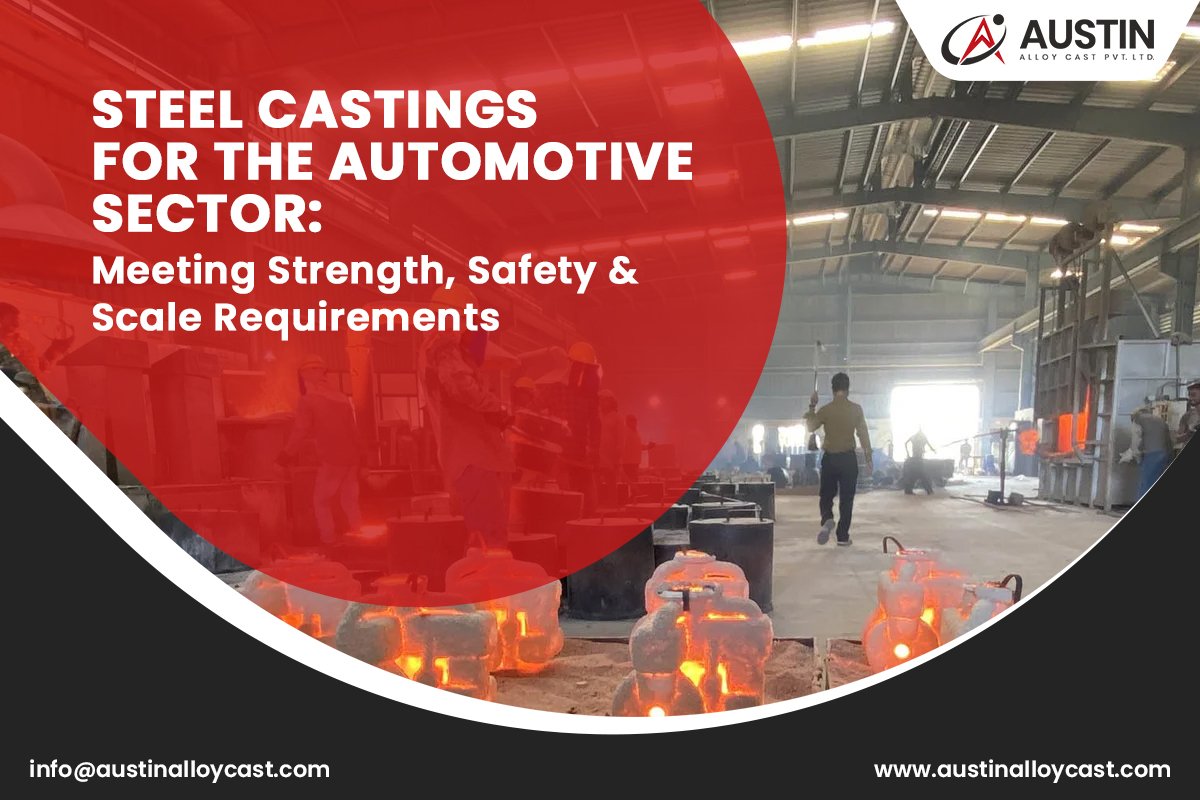
Automotive components live a demanding life. They absorb road shock, cycle through heat and cold, carry structural loads for years without failure, and in almost every case have to do it while meeting strict safety certifications and tight cost targets. For OEMs and Tier 1 suppliers sourcing cast components, steel casting sits at the intersection of three requirements that don’t always play well together: strength, safety, and scale.
At Austin Alloy Cast, we supply investment cast steel components into engineering and heavy duty applications where failure isn’t an option and volume isn’t negotiable. Here’s what automotive sourcing and design teams should understand about steel castings before locking in supplier decisions.
Why Steel Castings Still Matter in Automotive Manufacturing
Despite the industry’s ongoing shift toward lightweighting alternatives, steel castings remain essential wherever a component needs high strength to cost ratio, wear resistance, or the ability to survive repeated stress cycles. Steering knuckles, differential housings, suspension components, brake system parts, and various drivetrain elements are frequently cast in steel precisely because the material delivers predictable mechanical performance under real world abuse potholes, temperature extremes, and years of vibration.
Investment casting, in particular, allows automotive parts to be produced near net shape with complex geometries that would otherwise require extensive machining or multi part assemblies. That translates into fewer joints, fewer failure points, and often a lighter, more efficient part than a fabricated equivalent.
Strength: Designing for Real World Loads, Not Just Spec Sheets
Automotive components rarely fail under a single overload event; they fail from fatigue, accumulated over thousands of load cycles. This makes fatigue strength, not just tensile strength, one of the most important properties to specify correctly.
A few factors that influence real world strength performance:
- Grain structure and porosity control. Even minor internal porosity can become a crack initiation point under cyclic loading. Casting process control matters as much as alloy selection.
- Alloy selection matched to duty cycle. A part that sees constant vibration and shock loading, like a suspension component, needs different toughness characteristics than a static bracket.
- Heat treatment consistency. Mechanical properties promised on a data sheet are only realized if heat treatment is controlled and repeatable across every batch, not just the first sample lot.
OEMs should push suppliers for process documentation, not just certified test results on isolated samples, batch to batch consistency is what actually protects a vehicle program from field issues.
Safety: Where Casting Quality Becomes Non-Negotiable
Automotive castings frequently go into safety critical systems steering, braking, suspension where a hidden defect can have consequences far beyond a warranty claim. This is where casting quality assurance stops being a formality and becomes core to the sourcing decision.
Key quality checkpoints that matter for automotive grade steel castings include:
- Non-destructive testing such as radiography, dye penetrant, or magnetic particle inspection to catch internal or surface defects before parts ship.
- Dimensional verification against CAD models, especially for parts that mate with other precision components.
- Material traceability, so every casting can be traced back to its raw material heat and process batch if an issue ever surfaces in the field.
- Certification to recognized standards, giving OEMs documented assurance that the casting process itself is controlled and auditable.
Automotive sourcing teams should treat a supplier’s quality system, not just their price quote, as a primary qualifying factor, particularly for any part with safety or regulatory implications.
Scale: Producing Consistently, Not Just Once
A prototype casting proving a design works is only half the challenge. Automotive programs need suppliers who can reproduce that same quality across production volumes that may run into the tens of thousands of units annually, without drift in dimensional accuracy or mechanical properties.
Scaling steel casting production reliably depends on:
- Tooling design built for repeatability, not just first article approval.
- Process capability, meaning a facility that can hold tight tolerances consistently across long production runs, not just under ideal single piece conditions.
- Capacity planning, since automotive programs often need volume flexibility as vehicle demand shifts.
- Value added machining and finishing integrated into the supply chain, reducing the number of external touchpoints between casting and finished parts.
This is also where facility scale genuinely matters. A foundry that can handle heavier per piece weights and larger production volumes at a single location reduces the coordination risk that comes from splitting production across multiple smaller suppliers.
What This Means for Design and Sourcing Teams
Before finalizing a cast steel component for an automotive program, it’s worth working through a short set of questions with your casting partner:
- What is the actual fatigue and load profile the part will see in service, not just its static strength rating?
- What non-destructive testing and traceability does the supplier apply as standard, versus what’s optional?
- Can the supplier demonstrate consistency across production volume batches, not just prototype samples?
- Are machining and secondary processes handled in house or through additional vendors, and how does that affect lead time and quality control?
- Does the casting facility have proven capacity to scale with the program’s volume over its lifecycle?
Getting these answers early during design and supplier qualification prevents costly surprises once a part is locked into a vehicle program and production is running at full volume.
Partnering for the Long Run
Automotive steel castings sit under real pressure: they need to perform reliably for years, meet exacting safety expectations, and be producible at volume without variation. That combination rewards suppliers who treat process control, testing, and scalability as fundamentals rather than added extras.
At Austin Alloy Cast, we work with automotive and general engineering clients on investment cast steel components engineered for exactly this kind of demanding service from initial prototype through full production scale. If your program is evaluating cast component suppliers, it’s worth a technical discussion before designs are finalized.
To have a glimpse at our world class facility and products, visit us at www.austinalloycast.com.
For any queries or details contact us at info@austinalloycast.com.
Recent Posts