07 Sep 2026

BLOG
Carbon Steel vs Alloy Steel Castings: What OEMs Should Know Before Finalizing Designs
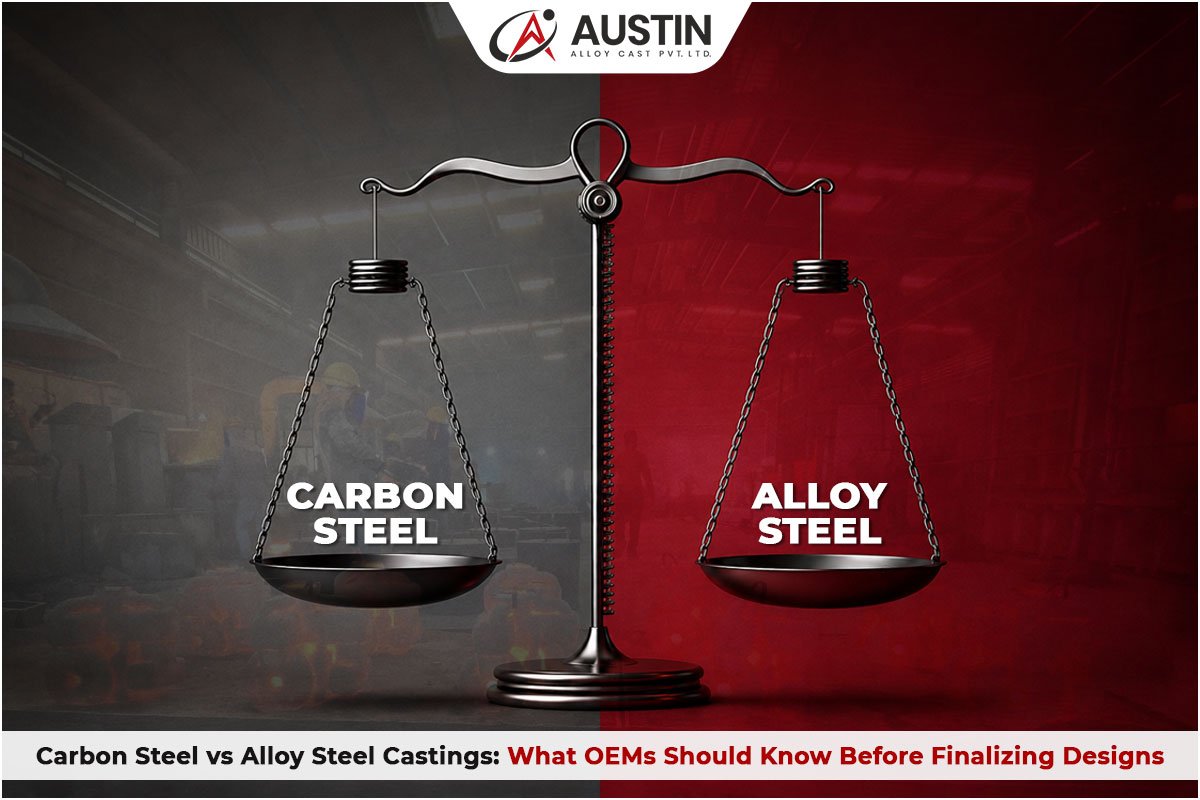
For OEMs designing components that will spend years under load, heat, pressure, or corrosive exposure, the choice between carbon steel and alloy steel castings is rarely just a spec sheet decision. It shapes tooling costs, lead times, machining behavior, and most importantly how the part performs once it leaves the drawing board and enters the field. Getting this call right early saves rework, redesigns, and expensive field failures later.
At Austin Alloy Cast, we work with design and procurement teams across valve and pump, oil and gas, mining, marine, and heavy equipment industries who are weighing exactly this trade off. Here’s a practical breakdown of what actually separates the two, and how to think through the decision before a design gets locked in.
The Core Difference
Carbon steel castings derive their properties primarily from carbon content, with minimal additional alloying elements. They’re straightforward, cost effective, and well understood, a dependable choice when the application doesn’t demand exceptional resistance to heat, corrosion, or wear.
Alloy steel castings, on the other hand, are engineered with deliberate additions, chromium, nickel, molybdenum, manganese, vanadium, and others to achieve specific mechanical or environmental performance. These additions change how the metal behaves under stress, temperature swings, and chemical exposure, often at a higher material and processing cost.
Neither is inherently “better.” The right choice depends entirely on what the part needs to survive.
Where Carbon Steel Makes Sense
Carbon steel castings are a strong fit when:
- The operating environment is relatively gentle, no aggressive chemicals, minimal thermal cycling, moderate loads.
- Cost control and shorter lead times matter more than marginal performance gains.
- The part will be coated, painted, or otherwise protected from corrosion externally.
- Machinability and weldability are priorities, since carbon steel generally machines and welds more predictably than higher alloy grades.
Structural brackets, housings, general engineering components, and parts operating in controlled indoor environments often fall into this category. If an OEM is producing high volumes of a component that doesn’t face harsh service conditions, carbon steel usually delivers the best balance of performance and cost.
Where Alloy Steel Earns Its Premium
Alloy steel castings justify their added cost when the part faces one or more of the following:
- High temperature service — alloys with chromium and molybdenum resist softening and scaling at elevated temperatures far better than plain carbon steel.
- Corrosive or wet environments — oil and gas wellheads, marine hardware, and chemical processing equipment routinely need the corrosion resistance that alloying provides.
- High wear or abrasive contact — mining, earth moving, and material handling components benefit from alloys engineered for hardness and toughness together.
- Critical structural loads — where fatigue resistance and toughness at both high and low temperatures cannot be compromised.
For valve and pump bodies handling aggressive media, or earth moving components subject to constant abrasive wear, alloy steel isn’t a luxury; it’s what keeps the part from failing well before its expected service life.
Design Considerations OEMs Often Overlook
Section thickness and casting behavior. Alloy steels can behave differently during solidification than carbon steel, affecting shrinkage patterns and the likelihood of porosity in thicker sections. Designs should account for this early rather than adjusting after tooling is cut.
Machining allowances. Higher alloy grades often require different cutting parameters and tooling. If your part has tight tolerances or complex machined features, factor this into both cost estimates and lead time expectations.
Weldability for repairs or assembly. If the component will need field welding or repair down the line, some alloy grades require preheating and controlled cooling to avoid cracking, a maintenance consideration that’s easy to miss at the design stage.
Heat treatment requirements. Many alloy steel castings need post cast heat treatment to achieve their intended mechanical properties. This adds a process step and should be built into project timelines from the start, not discovered mid production.
Total cost of ownership, not just unit price. A carbon steel part that fails or corrodes within two years can cost far more in downtime, replacement, and warranty claims than a slightly pricier alloy steel casting that lasts the full service life. OEMs designing for harsh or critical applications should weigh lifecycle cost, not just quoted price per piece.
A Practical Way to Decide
Before finalizing a casting material, it helps to walk through a few direct questions:
- What is the actual operating environment, temperature range, chemical exposure, load type?
- What is the expected service life, and what does failure cost in downtime or safety terms?
- Does the part require specific mechanical properties like impact toughness at low temperatures, or hardness for abrasion resistance?
- What are the machining, welding, and heat treatment implications for each material option?
- How do total lifecycle costs compare, not just initial casting price?
Answering these questions with real application data rather than defaulting to habit or the cheapest quoted option is what separates designs that perform reliably from those that need costly revisions after field deployment.
Getting It Right From the Start
Choosing between carbon steel and alloy steel castings isn’t just a materials question, it’s a design decision with downstream effects on manufacturability, cost, and long term reliability. The best outcomes happen when material selection is part of the conversation from the earliest design stages, not an afterthought once tooling is already underway.
At Austin Alloy Cast, we work alongside OEM engineering teams through the investment casting process from material selection and prototype development to full production to make sure the castings specified actually match the demands of the application.
To have a glimpse at our world class facility and products, visit us at www.austinalloycast.com.
For any queries or details contact us at info@austinalloycast.com.
Recent Posts