How a Strong Internal Culture Reflects in Every Casting We Deliver

In a foundry, culture is not a slogan on the wall; it is the reason a casting is either dependable in the field or a recurring problem on site. At Austin Alloy Cast, the internal culture shows up in how people think about safety, quality, and customer reputation long before metal is poured.

Culture starts with how we see ourselves

Austin Alloy Cast was established in 2015, but the mindset in the plant is that we are building relationships, not just parts. The team talks openly about “engraving lifelong relationships” with customers & employees, which means every decision on the shop floor is weighed against long term trust, not just this month’s output.

That thinking is reinforced by:

  • A professional, experienced management team with global exposure, which makes it easier to understand the expectations of US, UK, and EU OEMs.
  • A 350+ strong workforce aligned on a simple goal: deliver the highest level of customer satisfaction through consistent performance, not one off heroics.
  • A belief that honesty and integrity are non-negotiable, especially when dealing with critical applications and certifications.

When people are recruited, trained, and rewarded against these values, the castings naturally start to reflect that discipline.

One team, one responsibility for the final casting

Many foundries talk about departments; Austin treats the operation as one integrated system. Engineering, production, quality, and sales are not separate islands; they share responsibility for what eventually reaches the customer’s line.

You can see this in practical ways:

  • A strong engineering team is in place to support customers and to supervise manufacturing processes, rather than leaving design interpretation to chance on the shop floor.
  • “Convenience” is defined as a one stop solution from inquiry to delivery, meaning internal teams coordinate so the customer does not have to manage multiple vendors for casting, machining, and related processes.
  • Reliability is measured as “right time, right quantity, right condition”, so logistics and production planning are treated as part of quality, not just scheduling.

Because each function sees the entire casting journey, there is less finger pointing and more joint problem solving when issues appear.

Quality culture that goes beyond certificates

Austin Alloy Cast operates under a comprehensive quality umbrella, but the culture behind it is what makes the certificates meaningful. The company holds ISO 9001:2015, ISO 14001:2015, ISO 45001:2018, PED 2014/68/EU, UKCA, IBR, marine approvals (DNV, ABS, Lloyd’s, BV), and NORSOK M 630 Ed. 6, among others.

These are not just logos on the website; they drive day to day behaviour:

  • Non destructive testing (NDT) such as dye penetrant, magnetic particle, radiography (Ir‑192 and Co‑60), and ultrasonic testing is part of the routine, with 100% frequency specified for key methods.
  • A spectrometer with capability for Fe and Ni based alloys and 42 elements, including nitrogen analysis, ensures every heat is verified against the right alloy window before casting.
  • Weld Procedure Specifications (WPS) are formally approved, controlling how repairs are done and ensuring integrity is preserved instead of compromised.

This quality culture means that when a casting passes through Austin, it has been viewed through multiple technical and procedural lenses, not just a final visual inspection.

Culture of ownership shows in delivery and responsiveness

Internally, Austin talks about late delivery and quality issues as being “worth millions of dollars” for customers, and counts customer reputation as their own. That language changes behaviour: operators and managers understand that a small internal delay can become a serious commercial event at the customer’s site.

It translates into:

  • Just In Time manufacturing and stable quality as standard expectations, not premium options.
  • Quick sample development supported by dedicated employees who focus only on new projects or transitions from other suppliers, reducing risk during changeovers.
  • Proactive communication, backed by a technically sound and professional team that can talk detail with engineering and supply chain stakeholders in the customer organisation.

For the buyer, this shows up as fewer surprises, faster responses when questions arise, and smoother ramp ups on new parts.

Sustainability and responsibility built into everyday decisions

A strong internal culture is also measured by how a company treats its environment and community. Austin Alloy Cast has integrated sustainability into its operating model instead of treating it as a separate CSR topic.

Concrete examples include:

  • Use of green energy generated by a solar power plant with a total capacity of 1.5 MW, reducing the carbon footprint of every casting produced.
  • A focus on environmental compliance services as part of operations, not as an afterthought handled only during audits.

For global OEMs under pressure from CBAM‑style regulations and internal ESG targets, these choices add up to a casting supply that aligns with long term sustainability goals as well as technical specifications.

Scale and infrastructure that reflect long term commitment

Internal culture also appears in the investments a company is willing to make. Austin operates on a 25,000 m² land area, with 75,000 sq ft of constructed area and a dedicated 3,500 sq ft administrative office. It has built one of the largest single site investment casting facilities in India, capable of handling significant volumes and castings up to 150 kg per piece.

This scale is backed by:

  • State of the art infrastructure and operation & maintenance services to keep equipment reliable and processes stable.
  • Partnerships with group companies in sand casting (Metflow), rolled rings (Galaxy Technoforge), and machined components (Ayushi Engineering), allowing Austin to function as a broader metal processing partner.

Such investments signal to employees and customers that the business is built for the long term, encouraging a culture of continuous improvement rather than short term shortcuts.

What this means for every casting you receive

When you hold an Austin Alloy Cast component in your hand, you are not just looking at metal. You are seeing:

  • A culture that treats customer reputation as its own, pushing teams to deliver consistent quality and on time performance.
  • A workforce of 350+ people aligned on stable quality, reliable deliveries, and proactive professionalism.
  • A quality system backed by NDT capability, spectroscopy, and international certifications, all driven by internal discipline rather than external pressure.
  • An organisation that invests in green energy, modern infrastructure, and integrated partnerships to support future ready supply chains.

In other words, a strong internal culture is not an abstract idea at Austin Alloy Cast; it is built into the way every casting is designed, melted, inspected, documented, and shipped. That is why, over time, the culture you cannot see becomes the reliability you can measure in every application.
Lightweight Yet Strong: Advanced Alloy Casting for Modern Equipment

Modern industrial equipment is evolving rapidly. From energy and marine systems to automotive, mining, and heavy engineering machinery, manufacturers are under constant pressure to design components that are lighter, stronger, and more efficient without compromising durability or safety. At the heart of this transformation lies advanced alloy casting, a manufacturing approach that combines material science with precision engineering.

At Austin Alloy Cast Pvt. Ltd., advanced alloy casting is more than a production process; it’s a strategic solution that enables equipment manufacturers to meet today’s performance demands while preparing for tomorrow’s challenges. By leveraging carefully engineered alloys and precision investment casting techniques, Austin Alloy Cast delivers components that balance weight reduction with exceptional mechanical strength.

Why Lightweight Strength Matters in Modern Equipment

Weight reduction has become a critical design objective across industries. Lighter components lead to:

  • Improved energy efficiency
  • Reduced fuel or power consumption
  • Easier installation and handling
  • Lower operating and transportation costs

However, reducing weight cannot come at the expense of structural integrity or performance. Equipment operating in extreme environments, high temperatures, pressure, corrosion, or mechanical stress requires materials that can withstand harsh conditions over extended service life.

This is where advanced alloy casting plays a decisive role, enabling manufacturers to optimize strength to weight ratios without sacrificing reliability.

Understanding Advanced Alloy Casting

Advanced alloy casting involves the use of engineered metal alloys designed to deliver specific mechanical, thermal, and chemical properties. Unlike conventional cast materials, advanced alloys are tailored for:

  • High tensile and yield strength
  • Superior fatigue resistance
  • Excellent corrosion and wear resistance
  • Stability under extreme temperatures

Through investment casting, also known as precision casting, these alloys can be formed into complex geometries with tight dimensional tolerances and superior surface finishes. This eliminates unnecessary material bulk while maintaining load bearing capacity.

At Austin Alloy Cast, the investment casting process ensures that every alloy component performs exactly as intended batch after batch.

Key Alloys Used for Lightweight and High Strength Applications

1. Stainless Steel Alloys

Stainless steels offer an excellent balance of strength, corrosion resistance, and durability. Advanced grades allow designers to reduce wall thickness while maintaining structural performance, making them ideal for:

  • Pumps and valves
  • Food processing equipment
  • Marine and offshore components

2. Carbon and Low Alloy Steels

For applications demanding high mechanical strength and impact resistance, carbon and low alloy steels remain a strong choice. With precise alloy control and heat treatment, these materials can achieve exceptional strength levels without excessive mass.

3. Heat Resistant and High Performance Alloys

Modern equipment often operates in high temperature environments such as power plants, oil & gas facilities, and industrial furnaces. Heat resistant alloys maintain strength and dimensional stability even under thermal stress, enabling lighter component designs without compromising safety.

Austin Alloy Cast’s metallurgical expertise ensures that the right alloy is selected based on real world operating conditions, not just theoretical performance.

How Investment Casting Enables Lightweight Design

Investment casting is particularly well suited for producing lightweight yet strong components because it allows:

  • Complex internal geometries: Internal channels, ribs, and reinforcements can be integrated into the design without adding mass.
  • Near net shape production: Minimal machining reduces material waste and preserves design intent.
  • Uniform material distribution: Consistent wall thickness improves mechanical performance and reduces stress concentrations.
  • Superior surface finish: Reduces friction, wear, and the need for secondary processing.

By combining advanced alloys with precision casting, Austin Alloy Cast helps manufacturers achieve optimal performance with minimal material usage.

Performance Benefits for Modern Equipment Manufacturers

Improved Energy Efficiency

Lighter components reduce the energy required to operate machinery, improving overall system efficiency, an increasingly important factor in sustainability driven industries.

Enhanced Equipment Lifespan

Advanced alloys provide resistance to fatigue, corrosion, and thermal degradation, extending service life even in demanding environments.

Design Flexibility

Engineers gain greater freedom to innovate when material limitations are reduced. Complex shapes and functional integration become achievable without compromising strength.

Lower Total Cost of Ownership

Although advanced alloys may involve higher material costs, the long term savings from reduced maintenance, downtime, and energy consumption often outweigh the initial investment.

Quality Control: Ensuring Strength Without Compromise

Lightweight design demands absolute confidence in quality. At Austin Alloy Cast, quality assurance is embedded at every stage of production:

  • Chemical composition analysis to ensure alloy consistency
  • Controlled melting and pouring parameters
  • Non destructive testing (radiography, dye penetrant, magnetic particle inspection)
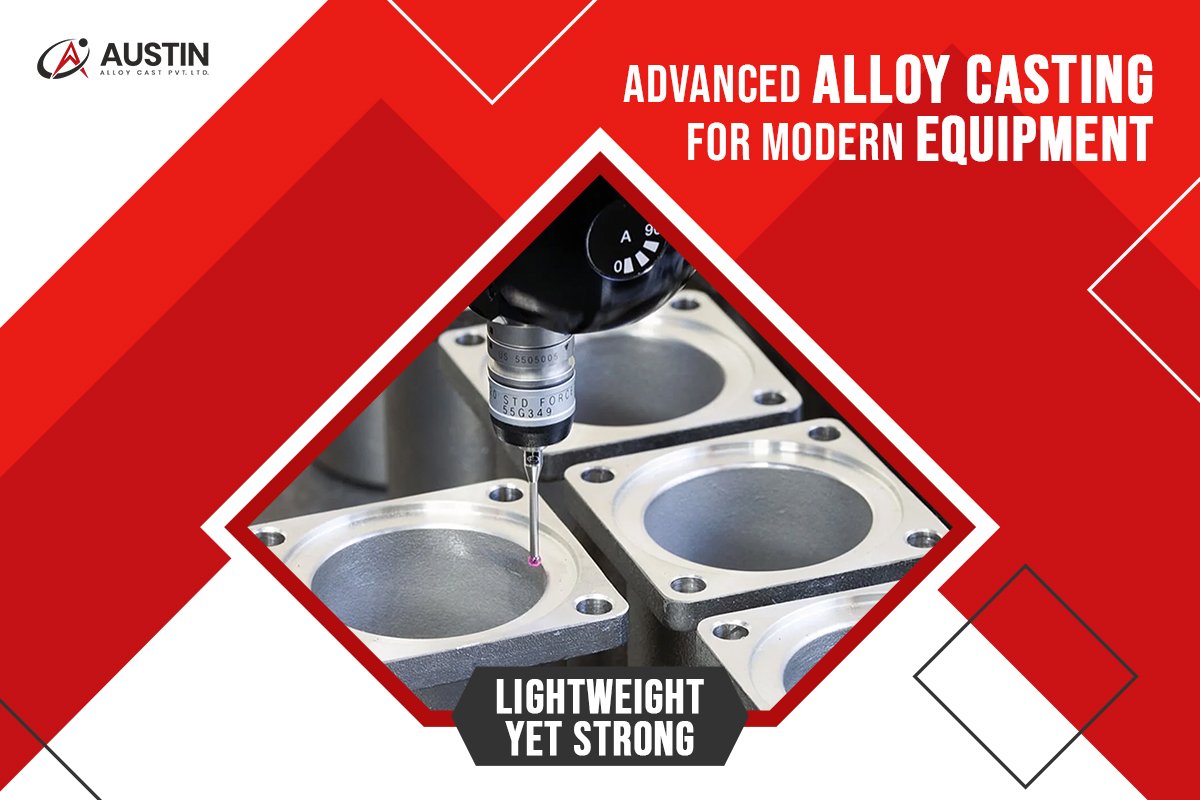
  • Dimensional verification using precision measurement tools
  • Mechanical testing to validate strength and performance

This rigorous approach ensures that every casting meets the required strength specifications even when material weight is minimized.

Applications of Lightweight, High Strength Alloy Castings

Advanced alloy castings from Austin Alloy Cast support a wide range of industries, including:

  • Oil & Gas: Valves, pump components, and pressure containing parts
  • Power Generation: Turbine components, heat resistant fittings
  • Marine & Offshore: Corrosion resistant structural and fluid handling parts
  • Mining & Heavy Equipment: Wear resistant components designed for high loads
  • Food Processing: Hygienic, corrosion resistant castings with reduced weight

Across these sectors, the demand for lighter yet stronger components continue to grow and advanced alloy casting is the solution driving that evolution.

Why Choose Austin Alloy Cast for Advanced Alloy Casting

Austin Alloy Cast Pvt. Ltd. brings together metallurgical expertise, advanced manufacturing infrastructure, and stringent quality systems to deliver reliable casting solutions for modern equipment manufacturers.

Key strengths include:

  • Extensive experience in precision investment casting
  • Capability to cast a wide range of ferrous and alloy steels
  • Integrated services including heat treatment and machining
  • Strong focus on repeatability and bulk order consistency
  • Commitment to international quality and compliance standards

By working closely with customers during the design and development phase, Austin Alloy Cast ensures that each component achieves the ideal balance between weight reduction and mechanical strength.

Conclusion: Engineering the Future with Lightweight Strength

As industries continue to demand higher efficiency, sustainability, and performance, the role of advanced alloy casting will only become more critical. Lightweight yet strong components are no longer optional; they are essential to the next generation of industrial equipment.

Through advanced materials, precision investment casting, and uncompromising quality control, Austin Alloy Cast Pvt. Ltd. helps manufacturers engineer components that are not just lighter, but smarter, stronger, and built for the future.

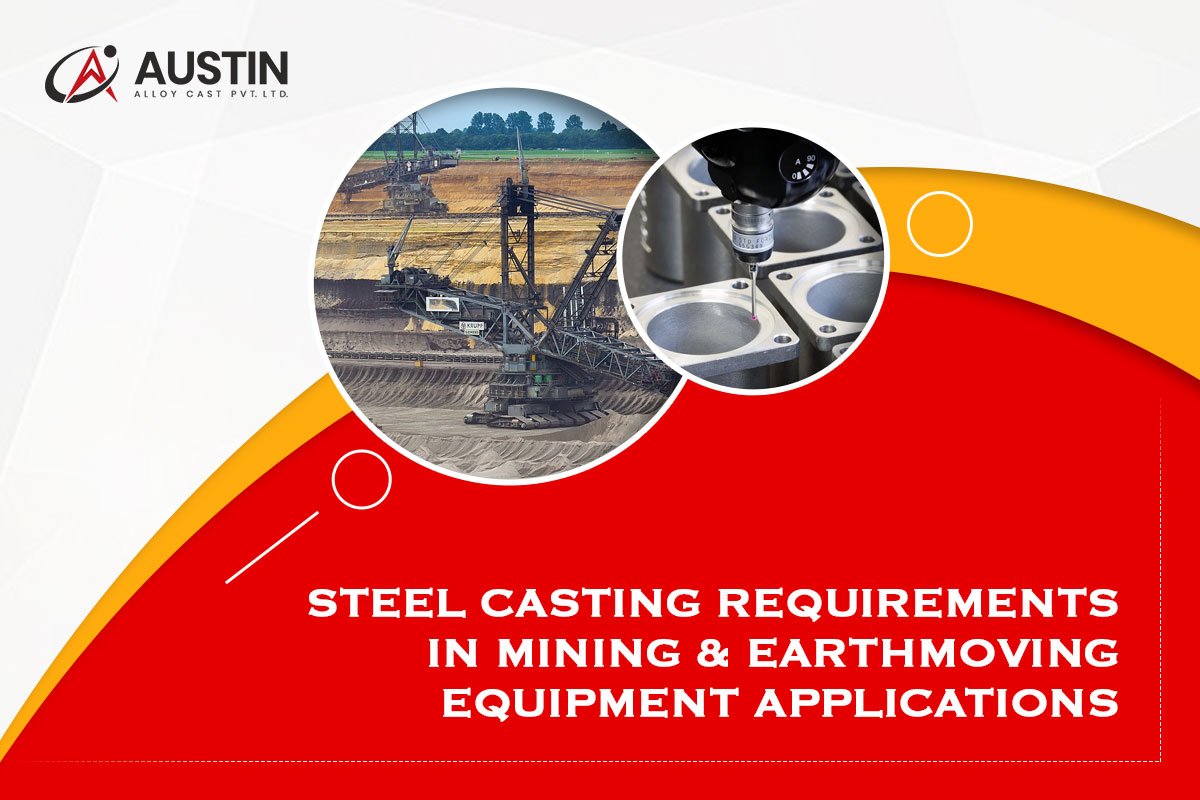
Steel Casting Requirements in Mining & Earthmoving Equipment Applications

Mining and earthmoving equipment live in one of the harshest environments a steel casting will ever see. Abrasive ore, impact loading, mud, shock, and constant vibration mean that “standard” casting quality is simply not enough. For OEMs, getting the steel casting requirements right is the difference between predictable uptime and expensive, unplanned rebuilds.

Where steel castings are used on mining & earthmoving equipment

On modern mining and earthmoving machines, steel castings are embedded deep into the load path and hydraulic system. Typical applications include:

  • Hydraulic cylinder components such as cap end covers and related high pressure housings, which must withstand continuous pressure cycling and shock loads.
  • Structural and powertrain parts associated with high horsepower diesel engines and drivetrains in loaders, dump trucks, excavators, and dozers, where casting integrity directly affects fatigue life.
  • Brackets, links, and mounting interfaces that connect ground engaging tools (GET), buckets, and booms to the main structure, often subject to combined bending, torsion, and impact.

These parts are rarely “cosmetic”; a single failure can stop a fleet, delay production, and put operator safety at risk.

Core performance requirements for mining grade steel castings

Because of this risk profile, steel castings for mining and earthmoving must meet a tighter set of requirements than general engineering castings.

Key expectations from serious OEMs include:

  • High integrity steel: Low porosity, controlled inclusions, and sound feeding to avoid shrinkage cavities, backed by radiography and ultrasonic inspection were critical.​
  • Toughness and fatigue resistance: Not just minimum tensile strength, but adequate impact values and fine, uniform microstructure to survive cyclic bending, pressure pulsations, and shock events.​
  • Dimensional stability: Castings must hold geometry through heat treatment and machining so hydraulic seals, bearing fits, and mating surfaces remain within tight tolerances.
  • Repeatability: Every production batch must align with the same mechanical and NDT criteria, so one “weak” lot does not enter a demanding mining site.

In short, the casting can’t simply pass a drawing once; it must deliver the same performance season after season in a very dirty, unforgiving workplace.

NDT and test requirements: proving integrity, not just chemistry

For mining and earthmoving components, surface finish and basic visual inspection are nowhere near enough. OEMs expect the foundry to verify what cannot be seen.

Austin Alloy Cast supports this by integrating:

  • X-ray (radiographic) testing to reveal internal shrinkage, gas holes, and structural discontinuities in highly stressed regions.​
  • Crack detection using magnetic particle or dye penetrant testing on critical surfaces such as sealing faces, fillets, and transition radii.​
  • Ultrasonic testing to pick up sub surface defects and laminations that could grow under repeated loading.​
  • Full chemical and mechanical analysis so every heat is tracked for composition and verified for tensile, yield, elongation, and, where required, impact properties.​

This multi layer test approach allows mining and earthmoving OEMs to sign off castings against global standards and internal risk criteria, not just supplier claims.

Material and process discipline behind reliable castings

Behind every robust mining grade casting is a disciplined combination of alloy selection, process control, and heat treatment.

Typical requirements include:

  • Alloy choice matched to duty: Medium and low alloy steels with balanced strength and toughness for structural parts; more wear resistant steels or alloy combinations where abrasion dominates.​
  • Controlled investment casting process: For complex shapes and tight tolerances, Austin Alloy Cast uses the lost wax investment casting route, benefiting from precise dimensional control and better surface quality.
  • Heat treatment tuned to section size: Normalizing, quenching, and tempering cycles defined for each casting family so the core and surface achieve consistent properties, especially important in thick section hydraulic and structural parts.​
  • Process traceability: Linking melt data, molding, heat treatment cycles, and NDT results to each batch so OEMs can audit and investigate any issue confidently.

This level of process ownership is what allows a casting to behave like a machined forging in service, without losing the design freedom and cost benefits of casting.

How Austin Alloy Cast supports mining & earthmoving OEMs

Austin Alloy Cast positions itself as a partner to global OEMs rather than a simple part supplier. For heavy and earthmoving equipment manufacturers, the company brings a combination of capacity, technical depth, and testing capability that matches mining sector expectations.

Key points that matter to buyers:

  • High integrity focus: The heavy & earthmoving segment is explicitly served with “high integrity steel castings”, backed by in house x ray, UT, crack detection, and chemical/mechanical analysis.
  • Experience with high horsepower engines: Austin’s castings already go into high performance and diesel engines for major tier 1 and OE customers, indicating familiarity with fatigue critical, high load applications.
  • One stop solution: With one of the largest single site investment casting facilities in India and the ability to support machining and other value added processes, Austin can deliver ready to assemble components for complex mining and earthmoving systems.
  • Consistent quality and delivery: The company explicitly frames late delivery and quality issues as “worth millions of dollars” for customers and aligns its internal culture around protecting customer reputation.

For mining and earthmoving OEMs, this combination reduces the number of suppliers to manage, simplifies audits, and lowers the risk of costly field failures.

What serious buyers should specify

When sourcing steel castings for mining and earthmoving equipment, buyers can significantly de risk programms by being explicit about requirements. Practical steps include:

  • Defining critical sections and weld repair policies clearly, with mandatory NDT levels for each area.
  • Calling out minimum impact values, hardness ranges, and heat treatment conditions appropriate for the working environment.
  • Requiring full NDT, chemistry, and mechanical test reports for initial samples and critical production lots.
  • Partnering with Austin Alloy Cast, that already has heavy & earthmoving experience and can participate early in design for manufacturability and reliability.

Done well, this turns the casting from a perceived risk into a controlled, predictable element of the mining equipment value chain supporting uptime, safety, and long term cost control on some of the toughest sites in the world.