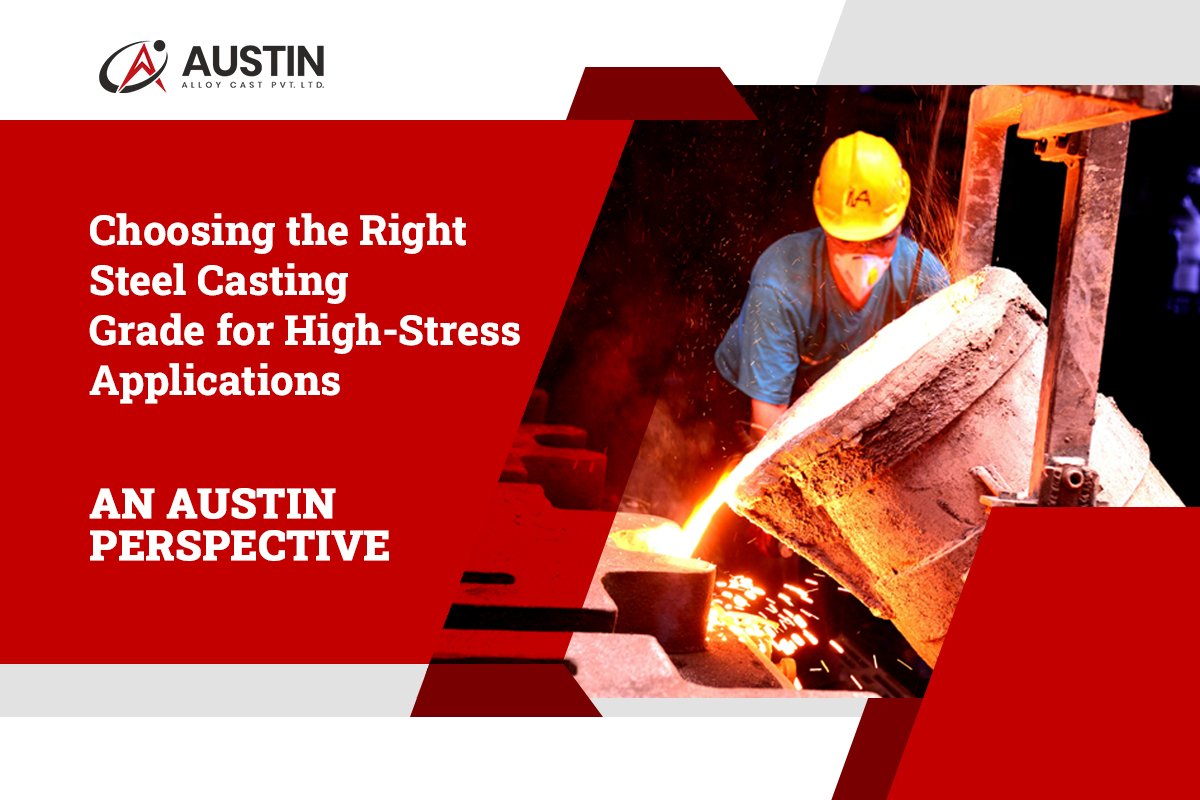
Choosing the Right Steel Casting Grade for High Stress Applications: An Austin Perspective

steel casting

In high stress industrial environments from heavy duty machinery and material handling equipment to mining, power generation, and oil & gas systems steel casting grade selection can mean the difference between years of reliable service and early component failure. At Austin Alloy Cast, choosing the right steel casting grade is viewed not as a routine specification exercise but as a strategic engineering decision that shapes wear life, fatigue resistance, and overall equipment availability. This article outlines the key considerations for selecting steel casting grades in high stress applications, from basic mechanical properties to real world service conditions.

Why steel grade matters in high stress castings

High stress components such as gear housings, pump casings, crusher parts, and structural frames are subject to repeated mechanical loads, impact forces, and sometimes abrasive or corrosive exposure. Simply specifying “cast steel” is insufficient; the exact steel casting grade determines how the material responds to stress, strain, and temperature cycles. The wrong grade can lead to cracking, brittle fracture, or accelerated wear, even if the casting geometry and process quality are excellent.

Austin Alloy Cast emphasizes that steel casting grade selection must align with the component’s loading profile, environment, and expected service life. For high stress applications, engineers need more than generic strength data; they require a clear understanding of toughness, fatigue resistance, and stability under operating temperatures.

Key mechanical properties to consider

When evaluating steel casting grades for high stress use, several core mechanical properties are critical:

  • Tensile and yield strength: High tensile and yield strength help components resist deformation and permanent damage under load.
  • Impact toughness and ductility: In shock loaded or low temperature environments, good impact toughness prevents brittle fracture.
  • Hardness and wear resistance: For components exposed to abrasion or sliding contact, higher hardness and controlled wear resistance improve longevity.
  • Fatigue strength: Components subjected to cyclic loading benefit from alloys with good fatigue resistance and controlled microstructure.

Austin Alloy Cast commonly works with carbon steels, alloy steels, and low alloy steels tailored to balance these properties. For example, a medium carbon alloy steel may be chosen for a gear housing that must combine strength with some impact resistance, while a higher alloy steel may be specified for crushing or mining components where wear and fatigue are dominant concerns.

Matching steel grade to service environment

Ambient conditions and operating environment heavily influence the choice of steel casting grade. High stress applications often occur in:

  • Very high or low temperatures
  • Moisture rich or mildly corrosive atmospheres
  • Dust laden or abrasive operating zones

For components that operate at elevated temperatures, steel casting grades must maintain strength and dimensional stability without excessive softening or creep. In low temperature environments, fracture toughness requirements grow, and low alloy steels with controlled chemistry and proper heat treatment are usually preferred. When corrosion or mild chemical exposure is present, stainless or corrosion resistant alloyed grades may be considered, even if the primary requirement is mechanical strength.

From an Austin perspective, the service environment is studied holistically: temperature profiles, media exposure, duty cycles, and potential stress concentrators such as sharp corners or holes are all factored into the steel grade recommendation.

Heat treatment and microstructural control

The same steel casting grade can perform very differently depending on heat treatment and microstructure. For high stress castings, common practices such as normalizing, quenching, and tempering are used to refine grain structure, relieve residual stresses, and optimize hardness and toughness. Controlled cooling and post cast heat treatment cycles are essential to ensure uniform properties throughout the section and to avoid localized weak zones.

Austin Alloy Cast emphasizes that heat treatment specifications should be viewed as an integral part of the steel grade selection process. A well chosen grade, combined with a suitable heat treatment, can deliver superior fatigue life, reduced susceptibility to crack initiation, and better response to machining and finishing operations.

Standards, codes, and traceability

Industrial high stress components are often governed by material standards such as ASTM, ISO, and EN specifications for cast steel. These standards define chemical composition ranges, mechanical property minimums, and testing requirements, providing a clear framework for selecting appropriate steel casting grades. Compliance with relevant codes also ensures that OEMs and end users can confidently integrate cast parts into larger systems without unexpected material performance issues.

From an Austin perspective, traceability is equally important. Every batch of steel casting is documented with heat lot records, material test reports, and process control data, enabling full traceability from ladle to finished component. This level of documentation is especially valuable for high stress applications in critical service, where maintenance, inspection, and failure analysis processes rely on accurate material history.

How Austin Alloy Cast supports smarter steel grade selection

For OEMs and industrial manufacturers, selecting the right steel casting grade for high stress applications is not a one size fits all decision. It requires collaboration between design engineers, foundry specialists, and metallurgists. Austin Alloy Cast partners with customers to evaluate load profiles, service conditions, and existing field failure data, then recommends steel casting grades that balance performance, manufacturability, and cost.

By aligning steel grade with geometry, process controls, and heat treatment strategy, Austin Alloy Cast helps ensure that every high stress casting behaves as intended, delivering reliability, reduced downtime, and a longer service life. In the world of demanding industrial applications, the right steel casting grade is not just a specification; it is a foundation for long term operational success.

Precision Valve Castings for Reliable OEM Applications

Precision valve castings are really important for the safety and performance of systems. These systems are used in oil and gas power generation, chemical processing, water treatment and general plant operations. Precision valve castings have to be able to handle a lot of pressure, heat and wear and tear. Precision valve castings also have to be able to control the flow of fluids well. At Austin Alloy Cast we do not think of precision valve castings as generic parts. We think of them as solutions that are designed to help systems work reliably.

Why Precision Matters in Valve Castings

Valves are like the control points in any system that handles fluids. If the valve castings are not made right, it can cause problems like leaks or erosion. Precision valve castings are made to strict standards. This means that the surfaces, patterns and flow paths all have to be perfect. When we make precision valve castings, we make sure that they will work perfectly with the parts of the system.

In OEM applications precision valve castings are often used in systems like pumps, compressors and process skids. In these systems it is really important that the valve castings are consistent and reliable. At Austin Alloy Cast we make sure that every valve body and valve trim casting is made to be precise and reliable. We want to make sure that our precision valve castings will work well for a time.

Material Selection for Precision Valve Castings

The material we use to make precision valve castings is really important. We use materials for different applications.

For example, we use:

  • Carbon and low alloy steels for general purpose valves.
  • Stainless steels for valves that need to be able to handle corrosion.
  • Duplex and super duplex stainless steels for valves that need to be able to handle pressure and corrosion.
  • Nickel. High alloy alloys for valves that need to be able to handle really tough conditions.

At Austin Alloy Cast we help our customers choose the material for their precision valve castings. We think about the operating conditions, the temperature range, the type of fluid and the expected service life. We want to make sure that every precision valve casting is made to work for its intended use.

Process Disciplines that Define Precision

We use methods to make precision valve castings, like investment casting and precision sand casting. These methods allow us to make shapes and control the dimensions really well. The key things we focus on are:

  • Pattern and mold quality: We make sure that the patterns and molds are accurate so that the internal passages and external flanges are perfect.
  • Melt control and metallurgy: We control the alloying, pouring temperatures and degassing to minimize defects.
  • Heat treatment and stress relief: We use controlled cycles to relieve internal stresses and improve mechanical properties.
  • Testing: We use destructive testing, hydrostatic testing and dimensional verification to make sure that every precision valve casting meets the required standards.

At Austin Alloy Cast we follow these disciplines closely to make sure that every valve body, bonnet and trim casting is made to the highest quality standards.

Advantages of Precision Valve Castings in OEM Designs

When OEMs use precision valve castings they get advantages. These include:

  • Machining and material waste: Our precision castings require less stock removal, which improves yield and reduces production time.
  • Flow efficiency: The internal passages and flow paths can be cast with smooth contours, which minimizes turbulence and erosion.
  • Consistent performance across batches: Our tight dimensional control and repeatable metallurgy allow OEMs to build assemblies with performance and minimal fitting or rework.
  • Lower total cost of ownership: Our precision valve castings longer are more leak-resistant and reduce maintenance downtime.

For OEMs that make pumps, compressors, process skids or industrial machinery our precision valve castings are a part of making sure their systems work reliably.

Meeting Global Standards and Certification Requirements

Modern industrial valves have to meet a lot of standards and codes. These standards govern things like pressure rating, material properties and testing requirements. At Austin Alloy Cast we make sure that our precision valve castings meet all the required standards. We provide casting documentation, material test reports and compliance ready records that align with project specific codes and customer quality expectations.

Partnering with Austin Alloy Cast for Precision Valve Solutions

For OEMs that deal with flow control requirements, material selection challenges or global supply chain demands working with a specialist in precision valve castings is a good idea. At Austin Alloy Cast we combine expertise with a focus on OEM-centric quality and delivery. By working early in the design stage OEMs can optimize valve geometry, material selection and casting strategy to make sure that every precision valve casting delivers the reliability expected in critical industrial applications.

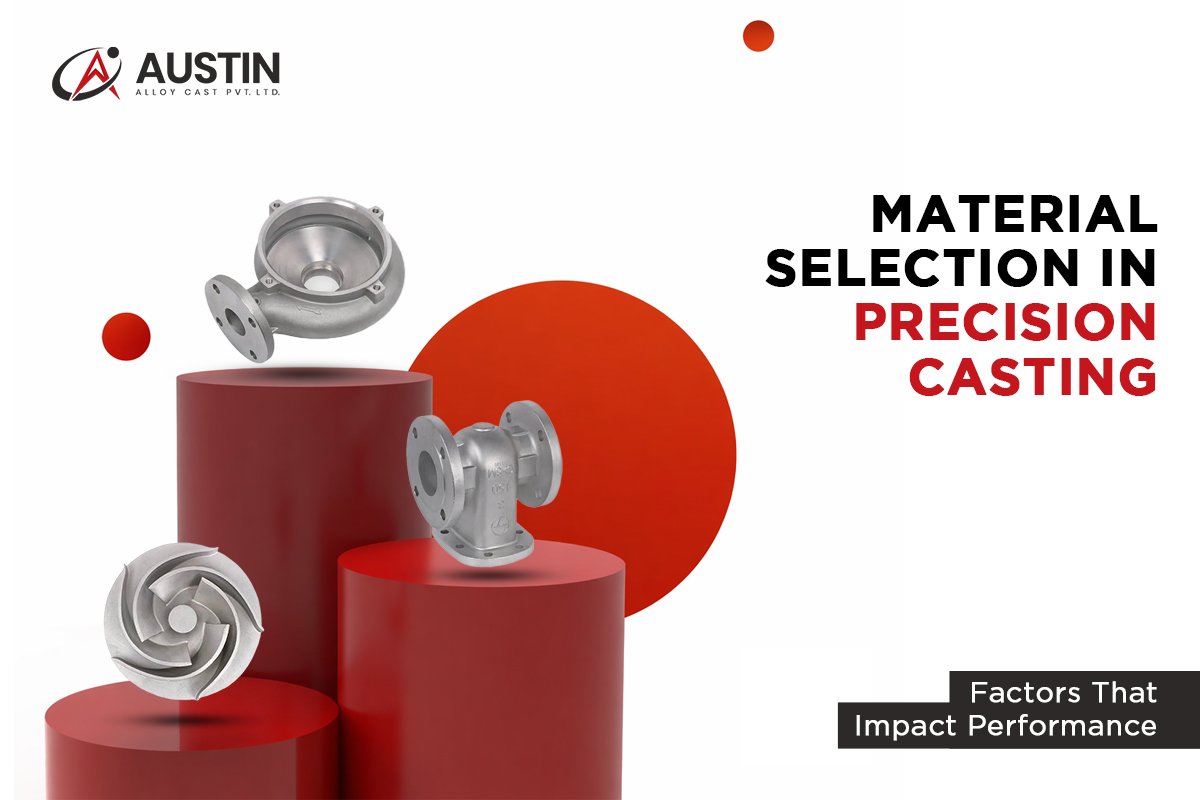
Material Selection in Precision Casting: Factors That Impact Performance

Material selection is one of the most influential decisions in precision (investment) casting, directly shaping how a component performs in service, how long it lasts, and how cost effective the final product is. At Austin Alloy Cast, we treat each alloy choice as a strategic design decision, not just a technical specification on a drawing.

In this article, we explore the key factors that impact performance when choosing materials for precision cast components.

Why material selection matters in precision casting

In precision casting, the alloy defines strength, corrosion resistance, dimensional stability, and service life under load and temperature. The wrong material can lead to premature wear, cracking, or corrosion, even if the part geometry and casting quality are excellent. On the other hand, the right alloy enhances reliability in demanding environments such as pumps, valves, and industrial machinery. At Austin Alloy Cast, we align material recommendations with the customer’s operating conditions, load requirements, and expected service life.

Key properties driving material choice

Several fundamental properties determine how an alloy will behave in a precision casting:

  • Mechanical strength and toughness: High tensile and yield strength, combined with adequate toughness, are essential for components under cyclic or dynamic loads.
  • Corrosion and oxidation resistance: We select stainless steels, nickel-based alloys, and cobalt-based superalloys when parts must withstand moisture, chemicals, or high-temperature oxidizing conditions.
  • Thermal stability and creep resistance: For turbine blades, exhaust components, or high temperature fittings, alloys must retain strength and dimensional stability even at elevated temperatures.
  • Wear and abrasion resistance: Components like pump impellers or valve trim benefit from alloys that resist erosion and surface degradation over long term operation.

By matching these properties to the application’s specific stresses, Austin Alloy Cast ensures that performance is optimized without over-specifying or overspending.

How process behavior affects material selection

The way a metal behaves during investment casting; its melt temperature, fluidity, shrinkage, and solidification pattern also influences material choice. Some alloys flow more easily into thin sections and complex geometries, reducing the risk of misruns or incomplete filling. Others shrink more during solidification, which can affect dimensional accuracy and require careful gating and pattern design. At Austin Alloy Cast, material recommendations are adjusted to align with the geometry, wall thickness, and critical dimension zones of the customer’s part.

Common alloys used in precision cast components

Different sectors typically lean toward specific alloy families:

  • Stainless steels: Widely used for their combination of strength, corrosion resistance, and moderate cost in valves, pumps, and process equipment.
  • Carbon steels: Offer high strength and toughness at lower cost, suitable for structural or mechanical components where corrosion exposure is controlled.
  • Aluminium alloys: Provide lightweight, good strength to weight ratios, and excellent castability, making them popular for automotive parts.
  • Nickel and cobalt base superalloys: Used where extreme temperature, corrosion, and stress resistance are required, such as turbine and compressor components.
  • Titanium alloys: Chosen for high strength, light weight, and excellent corrosion resistance in medical applications.

Austin Alloy Cast evaluates where each of these families best fits the customer’s functional and economic targets, avoiding generic “one size fits all” material assignments.

Service environment and lifecycle considerations

The operating environment heavily influences material selection. Components exposed to saltwater, acidic chemicals, or high pressure steam demand alloys with superior corrosion resistance and, in some cases, biocompatibility. For parts in high cycle or high vibration environments, fatigue and creep resistant alloys are preferred. Austin Alloy Cast customizes material choices based on factors such as temperature ranges, media exposure, duty cycles, and expected service life, ensuring long term performance and reduced maintenance costs.

Balancing cost, lead time, and manufacturability

Material selection is never made in isolation from cost and production feasibility. Some high performance alloys are more expensive to source and process, which can affect overall project economics even if the technical fit is perfect. Fabrication, heat treatment, and post cast machining requirements also vary by alloy, influencing lead time and yield. At Austin Alloy Cast, material options are evaluated in terms of total cost of ownership balancing upfront material cost, processing complexity, and expected lifetime performance so customers receive the most practical, not just the most exotic, solution.

Partnering with Austin Alloy Cast for smarter material decisions

Choosing the right material for precision casting involves far more than reading a datasheet; it requires understanding the entire ecosystem of loads, environment, and lifecycle. By combining material science insight with decades of experience in investment casting, Austin Alloy Cast helps OEMs and industrial manufacturers select alloys that deliver optimal performance, reliability, and value. If you are designing or sourcing precision cast components, consider partnering early in the process to align material selection with both engineering requirements and real world production constraints.