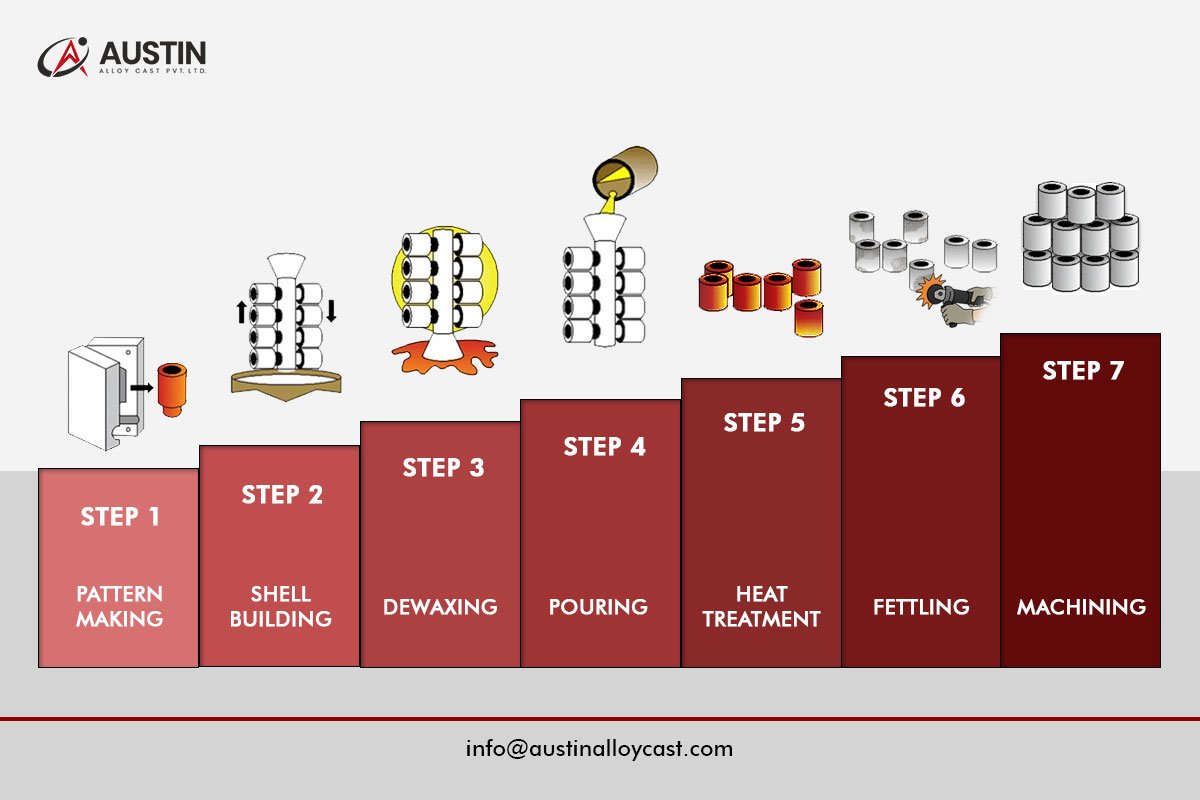
Choosing the right Steel Casting Partner is a major business decision for organizations importing precision parts to utilize in oil and gas end-uses, food processing equipment, heavy earthmoving equipment, and general engineering. Your steel castings’ quality, reliability, and performance are key factors impacting your equipment performance, production schedules, and project success. With the intricacy of international supply chains and the technological requirements of steel investment casting, selecting a suitable partner for your needs becomes a necessity. Casting process till date still remains the most fundamental process to any & all manufacturing activities across industries.
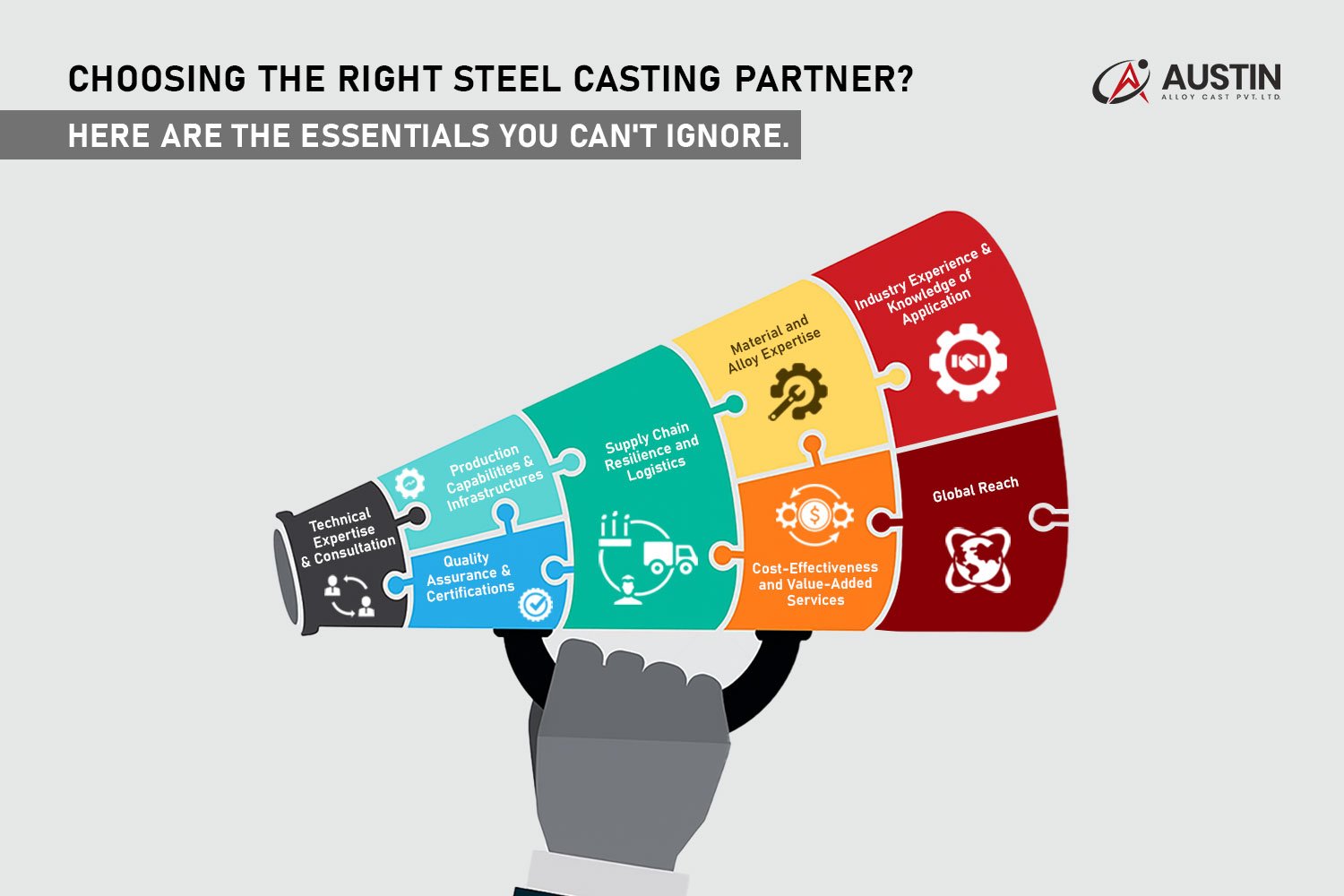
1. Technical Expertise and Consultation
A good Steel Casting Partner must not only manufacture—above all, they must provide professional technical consultation so that your project can be specially tailored. Steel investment casting is a highly technical process that requires expertise in the choice of alloys, design optimization, and manufacturing processes. A technical advisory partner like Austin Alloy Cast is keen to receive technical advice, helping the customer choose the most appropriate materials.
Austin Alloy Cast Pvt. Ltd. has played a pivotal role in supporting numerous customers by providing comprehensive metallurgical analysis and in-depth Design for Manufacturing (DFM) consultation. From the very beginning of the design process, their team of skilled engineers and metallurgists collaborates closely with clients, making recommendations on alloy selection based on factors like thermal operating conditions, mechanical stresses, corrosion resistance, and performance.
2. Production Capabilities and Infrastructures
Steel casting process, particularly investment casting, is skill-intensive and requires a robust infrastructure to support complicated geometries and large orders. In importing, make sure your Steel Casting Partner has a well-equipped factory with the ability to supply high-quality castings constantly. Austin Alloy Cast, for example, has one of India’s largest investment casting units with advanced capabilities in steel, stainless steel, and alloy steel castings.
3. Quality Assurance and Certifications
Quality should never be compromised in importing steel castings since lower quality parts cause machine failure or project delay. A suitable Steel Casting Partner should maintain strict quality control procedures, such as non-destructive testing (e.g., X-ray or magnetic particle inspection) and detailed test reports reflect that they take pride in industry standards. Austin Alloy Cast, for instance, has quality strictures to guarantee castings to become standards of required hygiene and precision demanded by industries like food processing.
A steel and alloy casting company such as Austin Alloy Cast Pvt. Ltd. often earns the following certifications. These certifications serve as proof of international compliance, quality, and safety.
ISO 9001:2015 – Quality Management System
Confirms that Austin maintains a consistent quality system and meets customer and regulatory requirements through continual process improvement.
PED 2014/68/EU – Pressure Equipment Directive Certification
Mandatory for supplying pressure-bearing components to the European market, especially in industries like oil & gas and steam systems.
AD 2000-Merkblatt W0 Certification
Required for supplying cast components for pressure equipment in Germany and other EU countries. Confirms metallurgical and process control capability.
ISO 45001:2018 – Occupational Health and Safety Management System
Illustrates a dedication to staff members health and safety in every aspect of production.
ISO 14001:2015 – Environmental Management System
Indicates environmentally responsible casting processes and waste management practices.
EN 10204 – Material Test Certificate (3.1/3.2)
Test certificates for chemical composition and mechanical properties of each heat batch, verified by internal or third-party inspection.
IBR (Indian Boiler Regulation) Certification
Essential for supplying castings used in boiler and steam applications within India.
Marine Approvals
Refer to certifications and quality validations required for materials, components, and manufacturing processes used in the marine and offshore industry. We have marine approvals from the various agencies like LR, ABS, BV, and DNV-GL.
Third-Party Approvals (Lloyd’s, TUV, DNV, BV, ABS etc.)
Recognitions from international third-party inspection agencies confirming Austin’s competence to meet project-specific or client-specific standards.
4. Supply Chain Resilience and Logistics
Steel Casting importation has to manage the world supply chain, where geopolitical tensions, manpower shortages, or logistics issues can impact it. Choose a Steel Casting Partner with a good supply chain and effective logistics to ensure timely supply. Austin Alloy Cast highlights the benefits of India as an acquiring location, highlighting its stable economy and large labor pool, which lowers the possibility of a labor shortage. The partner should also enable far-off taking of orders, consulting, and payment to make import easier in the post-COVID period. Procurement from different countries can also be employed to reinforce supply chains.
5. Material and Alloy Expertise
Material selection is the single most critical factor influencing the performance, durability, and cost-efficiency of steel castings. A capable and experienced steel casting partner will guide you through this choice—whether it’s carbon steel for cost-effective general use, stainless steel for corrosion-prone environments, or alloy steels for enhanced mechanical strength and heat resistance.
For instance, the food and pharmaceutical industries make extensive use of 300-series stainless steels, like 316L, because of their exceptional cleanability and resistance to corrosion. On the other hand, 400-series stainless steels offer superior hardness and wear resistance, making them suitable for automotive and general engineering applications.
What truly sets Austin Alloy Cast Pvt. Ltd. apart is our proven expertise in working with exotic and high-performance alloys, such as duplex stainless steels, super-austenitic grades, Inconel, and other nickel-based alloys. These materials are typically 4–5 times more expensive and far more demanding to process than standard steels. Successfully casting such alloys reflects not only our strong financial capabilities, but also the depth of our metallurgical and engineering knowledge.
Our team has consistently delivered complex components in exotic materials for industries like, oil & gas, marine, and chemical processing, where failure is not an option. By partnering with Austin, clients gain access to material science expertise, advanced melting technology, and precision process control—ensuring the right material is selected, processed, and delivered for their most demanding applications.
6. Cost-Effectiveness and Value-Added Services
Although cost is highly considered, the lowest cost might compromise quality. A good Steel Casting Partner is cost-effective but never compromises on quality. Look for foundries that are able to offer value-added products like machining, surface finishing (powder coating or zinc plating), and packaging that will be industry standard. Austin Alloy Cast, for instance, has post-machining and post-processing abilities to offer finished castings, reducing secondary vendors.
7. Industry Experience and Knowledge of Application
Finally, choose a Steel Casting Partner with a vast amount of industry experience in your own industry. For example, when requiring valve castings for the oil and gas sector, pressure transmitter housing for the pulp and paper sector, the foundry should have experience with your precise needs. Austin Alloy Cast has a decade of experience in providing components like valve trims, flow meter bodies, and prosthetic parts to oil and gas, food processing, and industries.
8. Global Reach:
Austin Alloy Cast Pvt. Ltd. is not just a domestic supplier—we are a global casting partner trusted by clients across continents. Our international presence is a result of strategic investments in infrastructure, partnerships, and customer-centric service delivery.
World-Class Manufacturing: Our production facility is located in one of the world’s most cost-efficient and quality-focused manufacturing hubs—India—ensuring high-quality castings at globally competitive prices.
Global Representation: We have local agents and technical representatives in key regions including North America, South America, Europe, and the APAC markets. This allows us to respond quickly to customer needs and offer real-time support.
US Warehousing Facility: With a dedicated warehousing and distribution center in the United States, we provide faster delivery, reduced lead times, and flexible stocking solutions for North American clients.
Seamless Communication: We prioritize cultural alignment, clear communication, and time-zone responsiveness. By bridging linguistic and geographic gaps, we ensure smoother collaboration and exceptional customer satisfaction across the globe.
Through this global approach, Austin Alloy Cast Pvt. Ltd. offers not just products—but reliable, localized service with a truly international footprint.
Conclusion
Selecting the best Steel Casting Supplier for importation requires technical expertise, process of manufacture, quality assurance, integrity of supply, knowledge of materials, cost reduction, and market orientation to be thoroughly evaluated. Placing these seven considerations first, you will be able to ensure your steel castings’ suitability for your use with lower cost and less risk. To have a foundry like Austin Alloy Cast, with up-to-date technology and years of industry experience, guide you through the process of importing can make it easier and offer you components to achieve the most from your project. Take a few minutes evaluating your partner’s capability, requesting samples, and conducting technical meetings to make the right decision.