15 Oct 2026

BLOG
Why Heavy Engineering Projects Demand Custom Steel Castings, Not Standard Solutions
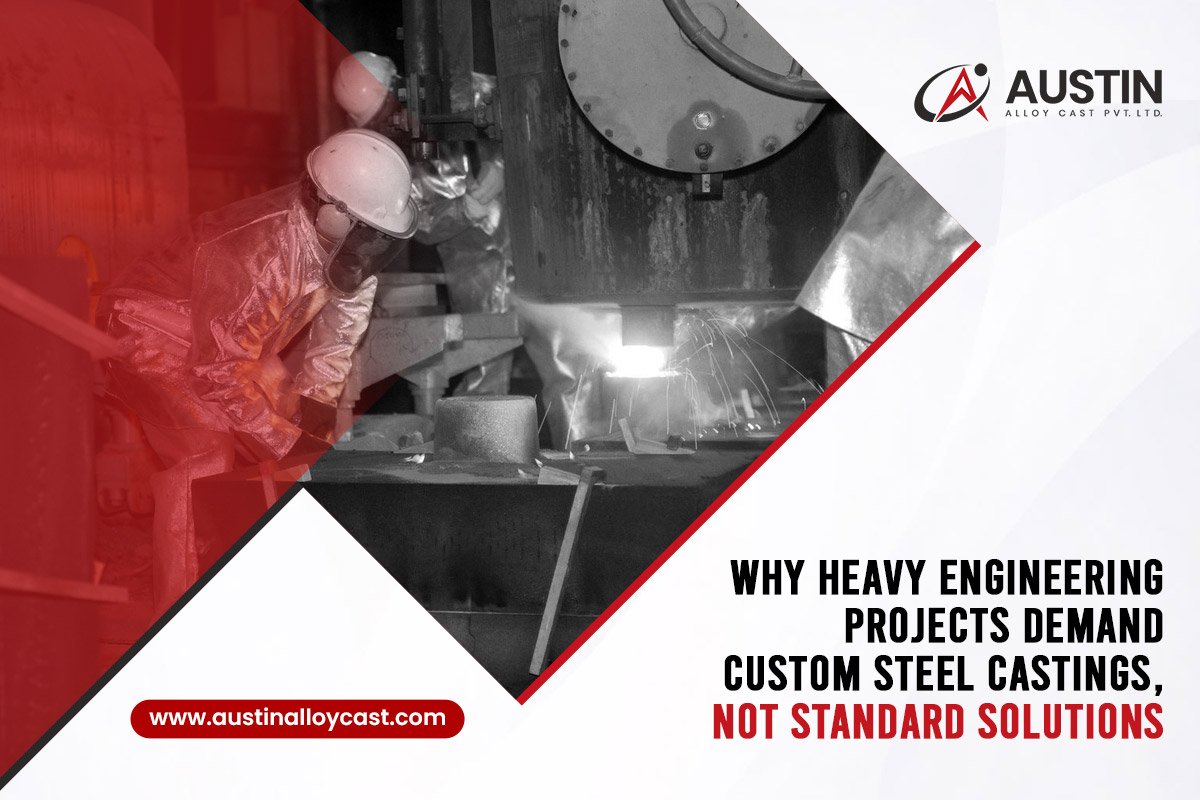
Heavy engineering rarely forgives compromise. Whether the project is a mining excavator, a hydroelectric turbine housing, a cement plant crusher, or a marine propulsion assembly, the components at its core operate under punishing loads, extreme temperatures, and relentless stress cycles. In this world, choosing an off-the-shelf part to save time or cost is often a decision that comes back to haunt the project. The engineers who build for the long term understand a simple truth: heavy engineering demands custom steel castings, not standard solutions.
Here is why that distinction matters so much.
Standard Parts Are Designed for Averages, Not Extremes
Off-the-shelf components exist because they serve the widest possible range of buyers. They are engineered around average conditions and generic load assumptions. That approach works well for ordinary machinery, but heavy engineering is defined by conditions that are anything but average.
A load-bearing bracket in a mining shovel, for instance, faces shock loads, abrasive dust, and constant vibration. A valve body in a power plant endures high pressure and thermal cycling for decades. Standard parts are simply not built for these specific realities. When they are forced into demanding roles, they fatigue early, crack under stress concentrations the designer never accounted for, or wear out faster than the maintenance schedule allows. The result is unplanned downtime, and in heavy industry downtime is measured in lost production worth enormous sums.
Custom Castings Match the Component to the Job
The greatest advantage of a custom steel casting is that it can be engineered for exactly one purpose. Instead of adapting a design around what already exists, engineers design the part around the actual application. That freedom shows up in several critical ways.
Material selection comes first. Different projects call for different alloys, whether the priority is high tensile strength, impact resistance, corrosion resistance, or performance at elevated temperatures. Custom casting allows the metallurgy to be tailored to the operating environment rather than accepting whatever a catalogue part happens to be made from. Steel, in particular, offers the high tensile and impact strength that load-bearing components subjected to dynamic forces genuinely require.
Geometry is the second advantage. Casting makes it possible to produce large, complex shapes as a single, structurally sound piece. Features that would otherwise require welding several parts together can be cast integrally, eliminating the weld seams that so often become points of failure. Fewer joints mean fewer weak spots, cleaner load paths, and a component that behaves as one continuous body under stress.
Complexity and Size That Fabrication Struggles to Match
Heavy engineering components are often physically enormous, sometimes weighing hundreds of kilograms or more, with internal cavities, varying wall thicknesses, and intricate contours. Machining such shapes from solid billet would waste vast amounts of material and machining time, and fabricating them from plate introduces distortion and residual stresses.
Casting sidesteps these problems. Molten steel takes the shape of the mould, so material goes only where it is needed. This conserves raw material, reduces machining, and produces near-net shapes that require far less finishing work. For large, one-of-a-kind, or low-volume components, which describes a great deal of heavy engineering work, casting is frequently the only economically sensible route.
Reliability Where Failure Is Not an Option
In sectors like mining, power generation, oil and gas, and cement production, a single failed component can halt an entire operation. The true cost of a part is never just its purchase price. It includes the risk it carries. A cheap standard part that fails in service can trigger cascading damage, safety incidents, and days or weeks of stopped production.
Custom castings reduce that risk at the source. Because they are engineered to the application, validated against the real loads, and produced with controlled metallurgy and inspection, they deliver the consistency and predictability that critical systems require. Engineers can specify mechanical properties, tolerances, and testing regimes that give them confidence the part will perform exactly as intended, batch after batch.
Precision Where It Counts
Large components still demand fine accuracy in the places that matter, such as bearing seats, mating faces, and bolt patterns. A microscopic deviation in these areas can throw off alignment across an entire assembly. Custom casting paired with precision machining allows manufacturers to hold tight tolerances precisely where the design requires them, while leaving non-critical surfaces as-cast. This targeted approach balances performance with cost far better than any standard component ever could.
Engineering for the Long Haul
Ultimately, heavy engineering is an investment measured in decades, not seasons. The machinery must run reliably long after it is commissioned, often in remote or hostile environments where replacements are difficult and expensive to install. Custom steel castings support that longevity by delivering components matched to their duty, free of unnecessary weak points, and built to endure.
Standard solutions have their place in the world of ordinary equipment. But when the stakes are high, the loads are severe, and failure is simply not acceptable, custom steel castings are not a luxury. They are the foundation on which dependable heavy engineering is built.
To have a glimpse at our world class facility and products, visit us at www.austinalloycast.com.
For any queries or details contact us at info@austinalloycast.com.
Recent Posts