How to Ensure Consistent Quality in Bulk Casting Orders

Achieving high quality across massive casting runs isn’t merely helpful; it shapes how well products work, whether customers stay happy, and whether the company lasts. Sectors like cars, power systems, ships, factory gear, and tough construction work demand exact matches over and over. Hitting that mark without fail means following tight routines, using advanced tools, and double checking every detail again and again.

When it comes to making large numbers of cast parts, Austin Alloy Cast Pvt. Ltd stands out in India. This company uses tried and tested methods along with strong engineering practices to maintain steady quality throughout its production runs. Starting from choosing raw materials, each phase up to final checking follows a path focused on consistency, clear records, and meeting global industry rules.

In this article, we explore the core strategies to ensure consistent quality in bulk casting orders and how foundries can implement them effectively.

1. Select the Right Materials and Maintain Strict Alloy Control

The foundation of quality casting lies in material consistency. Even small variations in alloy composition can lead to significant differences in strength, wear resistance, corrosion performance, and dimensional stability.

Best practices include:

  • Working with reputable material suppliers with documented traceability.
  • Performing incoming chemical analysis and physical property testing for each batch.
  • Maintaining accurate alloy documentation and certifications to ensure materials meet specifications.

At Austin Alloy Cast, we cast a wide range of materials from carbon and stainless steels to high performance alloys ensuring that each batch matches the specified chemistry and mechanical properties required by the application.

2. Use Advanced Process Engineering and Simulation Tools

Bulk orders often mean repeating a complex technical process hundreds or thousands of times. Variations in temperature, mold filling, solidification, or cooling can lead to defects such as misruns, porosity, shrinkage, or cold shuts if not properly controlled.

Modern foundries combat this by:

  • Using 3D design and solidification simulation software to predict metal flow and cooling behavior.
  • Optimizing gating and riser systems to promote uniform filling and reduce internal defects.
  • Standardizing furnace temperatures, melt handling, and degassing procedures.

Simulation not only identifies potential trouble spots early, but when integrated with real world process controls, it enables consistent reproduction of high quality castings across bulk production runs, a core capability at our facility.

3. Maintain Precise Control Over Molding and Casting Parameters

The repeatability of a casting process is directly tied to how well mold making and pouring operations are controlled.

Key considerations include:

  • Mold quality and maintenance: High precision ceramic or refractory molds with tight tolerances help achieve consistent dimensional accuracy.
  • Temperature consistency: Monitoring and controlling melting, pouring, and cooling temperatures ensures metal properties remain uniform.
  • Environmental control: Clean, temperature regulated workshops reduce the risk of contamination and defects associated with humidity or particulate matter.

Austin Alloy Cast’s investment casting process is engineered to ensure dimensional precision and surface finish consistency, enabling predictable performance even across large batches.

4. Implement Rigorous Quality Assurance Throughout the Production Cycle

Consistent quality is not a matter of inspecting finished parts alone; it’s about embedding quality throughout the entire production chain.

A robust QA framework should include:

  • In process monitoring: Track critical parameters such as melt temperature, pouring rate, and cooling profiles.
  • Non Destructive Testing (NDT): Techniques like radiography, ultrasonic testing, magnetic particle inspection, and dye penetrant tests help detect internal or surface defects without harming the part.
  • Dimensional and mechanical testing: Coordinate Measuring Machines (CMM), hardness tests, and tensile testing ensure parts meet design tolerances and performance criteria.
  • Documentation and traceability: Keeping detailed logs of raw materials, process parameters, quality checks, and inspections allows discrepancies to be pinpointed quickly and corrective actions implemented.

By integrating NDT into multiple production stages not just at the end, Austin Alloy Cast minimizes rework, reduces scrap rates, and assures customers that each casting complies with both design and regulatory standards.

5. Standardize Procedures and Train Skilled Operators

Consistency requires people as well as processes. Standard Operating Procedures (SOPs) should guide every step of casting production, from wax pattern preparation to shell building, pouring, heat treatment, and finishing.

Best practices include:

  • Creating documented SOPs for each operation and regularly updating them based on process improvements.
  • Establishing Statistical Process Control (SPC) charts to monitor key quality parameters and detect drift early.
  • Training foundry staff and quality inspectors on the latest casting technology, inspection techniques, and quality standards.

Competent and well trained personnel are critical to interpreting data, executing processes reliably, and preventing inconsistencies that can compromise large orders.

6. Foster Continuous Improvement Through Feedback Loops

Bulk casting quality isn’t static; it evolves through continuous improvement.

Companies should:

  • Analyse production data to identify patterns, defect trends, or equipment wear.
  • Solicit feedback from customers to refine specifications and enhance product performance.
  • Regularly review and revise quality plans, incorporating lessons learned from previous orders.

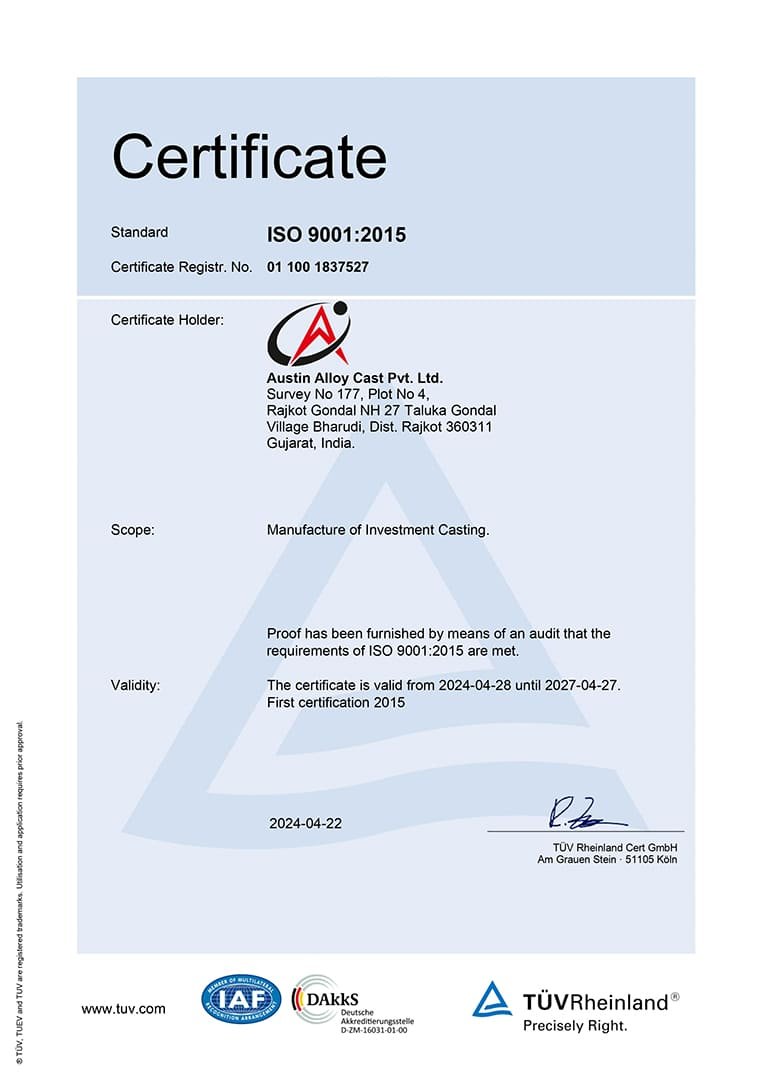
Quality management systems like ISO 9001 which Austin Alloy Cast adheres to help formalize this continuous improvement cycle and embed it into the company culture.

7. Partner With Foundries That Offer Integrated Services

Finally, partnering with a foundry that provides end to end capabilities can significantly improve quality consistency in bulk orders. Facilities that combine casting, machining, heat treatment, testing, and finishing under one roof reduce variability introduced by handoffs between vendors.

Austin Alloy Cast’s integrated model encompassing investment casting, heat treatment, CNC machining, and comprehensive testing ensures tight control over each step in the production lifecycle, delivering castings that are ready to use with minimal additional processing.

Conclusion: Consistent Quality Is the Sum of Excellent Components

Ensuring consistent quality in bulk casting orders is not a single action; it’s a strategic blend of material control, advanced process engineering, meticulous inspection, skilled people, and continuous improvement. By embedding these principles into every production stage, manufacturers can deliver reliable, repeatable cast components that meet even the most demanding industrial requirements.

At Austin Alloy Cast, we’ve built our reputation on this foundation from raw material selection to final inspection and delivery helping customers across the globe trust that their bulk casting orders are manufactured with precision, integrity, and unwavering quality.
Heat Treatment in Steel Castings: Why It Matters More Than Most Buyers Realize

Most buyers think of heat treatment as a line item on a certificate. In reality, it is the step that quietly decides whether a steel casting will work flawlessly for years or start causing headaches in the field. When heat treatment is right, nobody notices; when it is wrong, everyone does.

Bringing heat treatment down to earth

In a foundry, heat treatment is simply about heating and cooling steel in a controlled way so the inside of the casting matches the expectations on the drawing. It is less about “fancy metallurgy” and more about making sure the part can survive real pressure, vibration, and thermal cycles without surprises.​

In practical terms, good heat treatment helps steel castings to:

  •         Relax the hidden internal stresses that are locked in during solidification and cooling.​
  •         Clean up the coarse, as cast structure so the material becomes tougher and more predictable under load.​
  •         Hit the actual working numbers: strength, hardness, toughness, and fatigue life, not just chemistry.​

If this step is rushed or treated casually, the casting may still “look” good and even pass some basic checks, but its behavior in service can be very different.

What really happens in the furnace

For carbon and low alloy steel castings, most industrial heat treatment falls into a few well known patterns, but each foundry sets its own exact recipes.​

Common routes include:

  • Normalizing: Heating above the critical range, holding so the whole section is at temperature, then air cooling. This evens out the microstructure and makes the casting easier to machine and more consistent in service.​
  • Quenching and tempering: Heating high, quenching in water or oil to lock in strength, then tempering to bring back toughness and control hardness. This is used wherever higher strength and wear resistance are needed.​
  • Stress relieving and annealing: Lower temperature cycles used to take out residual stress or soften the structure before heavy machining, which reduces distortion and cracking risk.​

On paper this sounds simple, but in the shop, they involve careful decisions on furnace loading, heating rate, holding time for thick vs thin sections, and how fast and in what medium to cool. Small shortcuts here often show up months later as distortion, leakage, or cracks.​

Why most buyers miss the risk

From a buyer’s chair, the PO may only say “Normalize and temper as per spec” and the certificate will list a few mechanical values. This creates the illusion that every supplier is doing more or less the same thing. In reality, three big gaps usually sit behind that line item:

  • The microstructure is invisible on the cert. Two suppliers can match a minimum tensile value yet deliver very different grain size, phase balance, and residual stress and therefore very different fatigue performance.​
  • Section thickness is not just a dimension; it changes how heat flows. Without adjusting cycles for heavy sections, the skin can be well treated while the core remains under transformed.​
  • Consistency over time is rarely discussed. Furnaces drift, loading changes, and operators rotate. Without tight process control, the “same” heat treatment on paper can become three different processes across a year.​

This is why field failures often trace back not to “wrong material” but to non-uniform or inconsistent heat treatment on an otherwise correct grade.

The hidden cost of getting it wrong

When heat treatment is treated as a cheap service instead of a critical process, the real bill usually appears later in the lifecycle.​

Typical consequences include:

  • Casting distortion that only shows during machining or assembly, forcing rework, shimming, or complete replacement.​
  • Random cracking and leaks in pressure bearing components after a few months of thermal cycling or vibration.
  • Unpredictable wear behavior: some batches last, others wear out early, even though they carry the same specification.
  • Extra inspections, audits, and customer discussions to explain why properties or performance shifted between lots.

For an OEM, this turns a slightly cheaper casting into a very expensive component once downtime, warranty, and brand impact are considered.

What smart buyers actually ask

Experienced US and UK buyers who have been burned before are now treating heat treatment as part of supplier qualification, not a tick box. Instead of asking only “Is it heat treated?”, they also ask:​

  • “What exact cycle do you use for this grade and section thickness, and how was it developed?”
  • “Are your furnaces temperature mapped and calibrated? Can you show the records linked to actual heats?”​
  • “How do you ensure parts with very different wall thicknesses come out with uniform properties?”​
  • “Where do you take test bars from, and how do you confirm they represent the real casting?”

Suppliers that can answer this calmly with data, not just reassurance, usually have much lower noise in the field.

How Austin Alloy Cast handles heat treatment

At Austin Alloy Cast, heat treatment is treated as part of metallurgy, not just a production step. The mindset is that a casting is only truly finished once the microstructure and properties are locked in and proven not just once it comes out of the mold.

The approach includes:

  • Grade and family specific thermal recipes with clear temperature windows, soak times, and loading rules built around section thickness and alloy behavior.
  • Integrated control: furnace charts, chemical analysis, hardness checks, and mechanical tests are tied together so each batch can be traced and explained, not just shipped.
  • Use of multi step testing where required mechanical tests, hardness mapping, and, for demanding jobs, microstructural checks to confirm that the inside of the casting matches the promise on the drawing.​
  • A focus on in house capability to avoid long waits and loss of control when sending castings out for thermal processing, which also helps with lead time on urgent programmes.​

For global OEMs, this means fewer surprises, more predictable launches, and castings that behave the same way from prototype through to mature production.

Why this “invisible” step deserves more attention

The simple truth is this: most casting discussions still revolve around alloy, geometry, and machining, while heat treatment gets one line on the spec. Yet it is often the single most important lever for long term reliability.

For buyers, taking heat treatment seriously, asking better questions, demanding real data, and choosing foundries that invest in this area is one of the fastest ways to reduce failures without changing the drawing or upgrading to more expensive alloys. For Austin Alloy Cast, that is exactly where a lot of value is created: in a process that is rarely seen, but always felt in the performance of the final part.

Understanding Foundry Certifications: What They Actually Mean for OEM Buyers

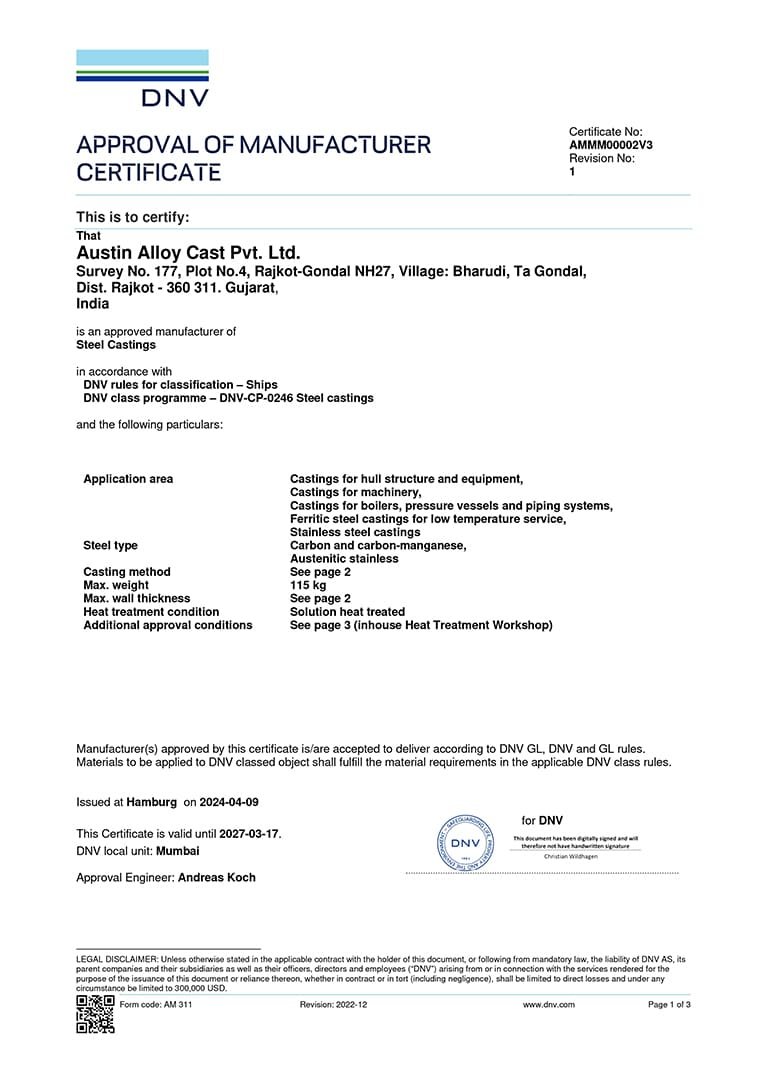
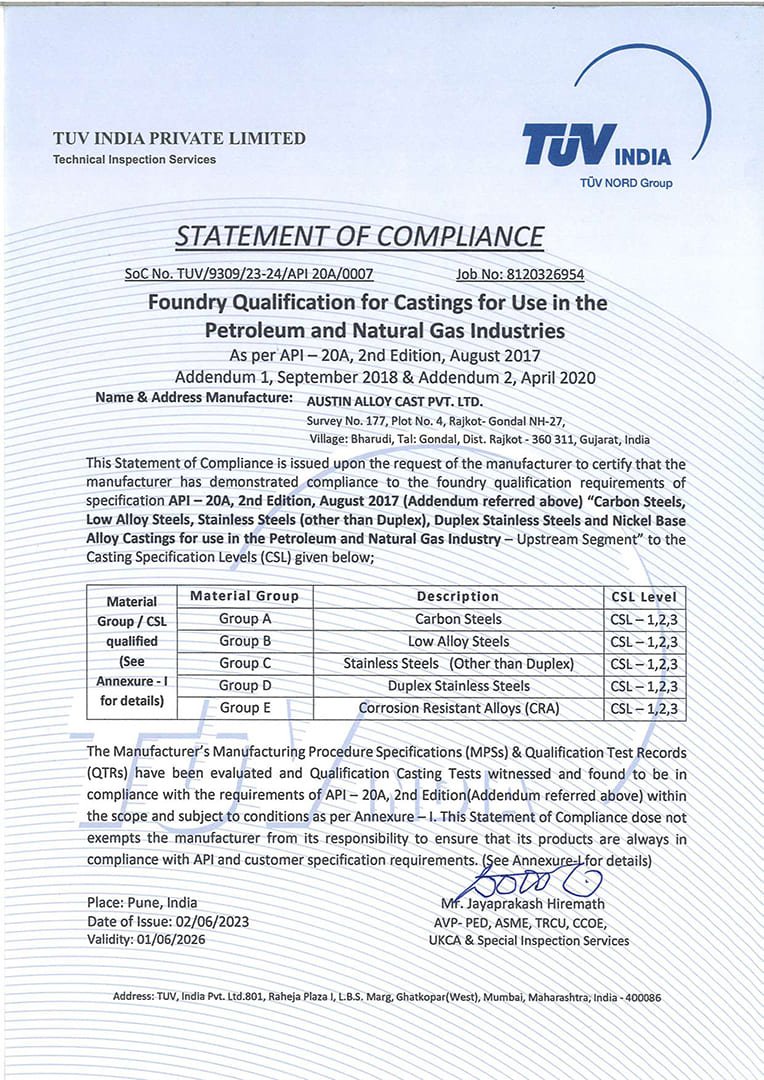
When you are under pressure to launch a new programme or keep an existing line running, it is easy to treat foundry certificates as a checkbox, “ISO? PED? Marine society approvals? Good, move on.” In reality, those certificates hide years of discipline, audits, and process control that directly affect whether the castings on your line behave like reliable components or recurring problems. This is exactly why, at Austin Alloy Cast, we take certifications seriously and why OEM buyers should too.

Why certifications matter beyond logos on a website

From an OEM perspective, certifications are really a shortcut to one question: “Has this foundry proven it can run a stable, audited system that protects my brand?” A certificate does not pour metal, but it forces the foundry to document, monitor, and improve how it works every single day.

For buyers, that translates to:

  • Lower risk of random quality escapes because processes are defined, followed, and verified.
  • Easier internal approvals, since certified suppliers align with your own quality, safety, and environmental policies.
  • Smoother customer and regulatory audits, where third party credentials support your sourcing decisions.

In other words, certifications are not marketing; they are part of your risk management toolkit.

ISO 9001:2015 – What it really tells you

Almost every serious industrial supplier claims ISO 9001, but buyers often underestimate what it actually demands. ISO 9001:2015 is a quality management standard that requires the foundry to control everything from contract review and design support to production, inspection, calibration, and corrective actions.

At Austin Alloy Cast, ISO 9001:2015 means:

  • Every order starts with a clear review of requirements and feasibility, rather than assumptions on the shop floor.
  • Processes are documented and audited, so critical steps wax injection, shell building, pouring, heat treatment, NDT follow agreed methods, not individual habits.
  • Non conformances trigger root cause analysis and corrective actions, creating learning loops instead of repeated problems.

For OEMs, this reduces the “surprise factor” and builds confidence that issues will be handled systematically, not just patched.

ISO 14001 & ISO 45001 – Why EHS certifications matter to buyers

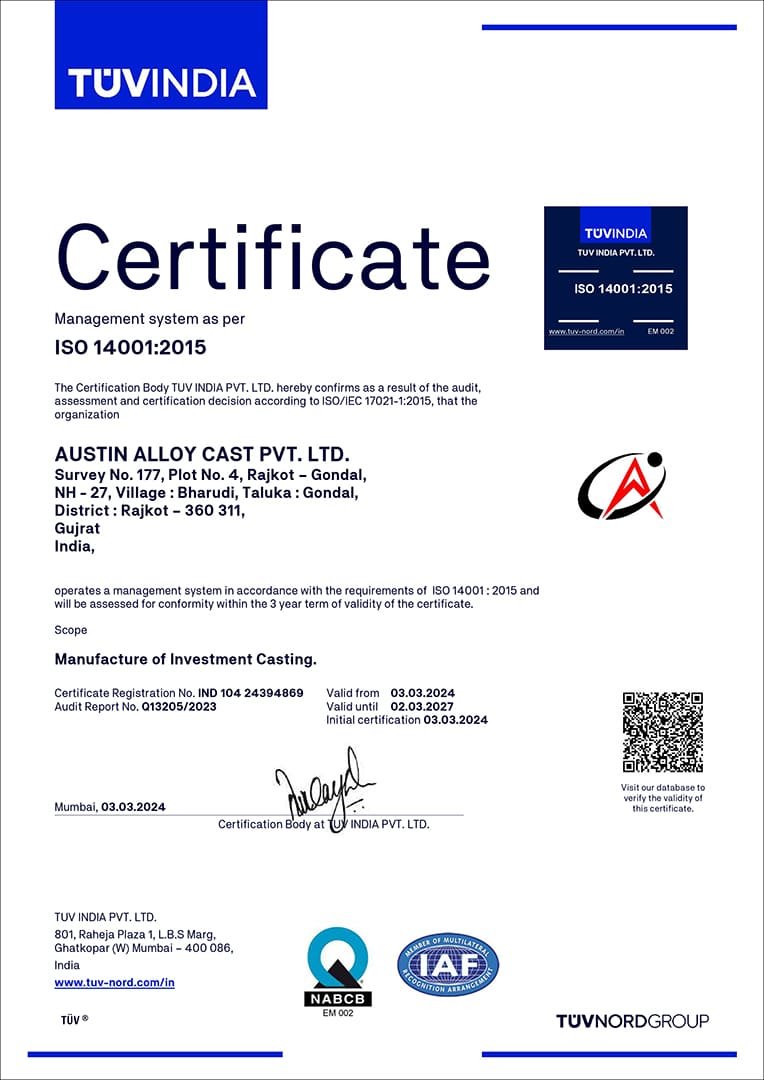
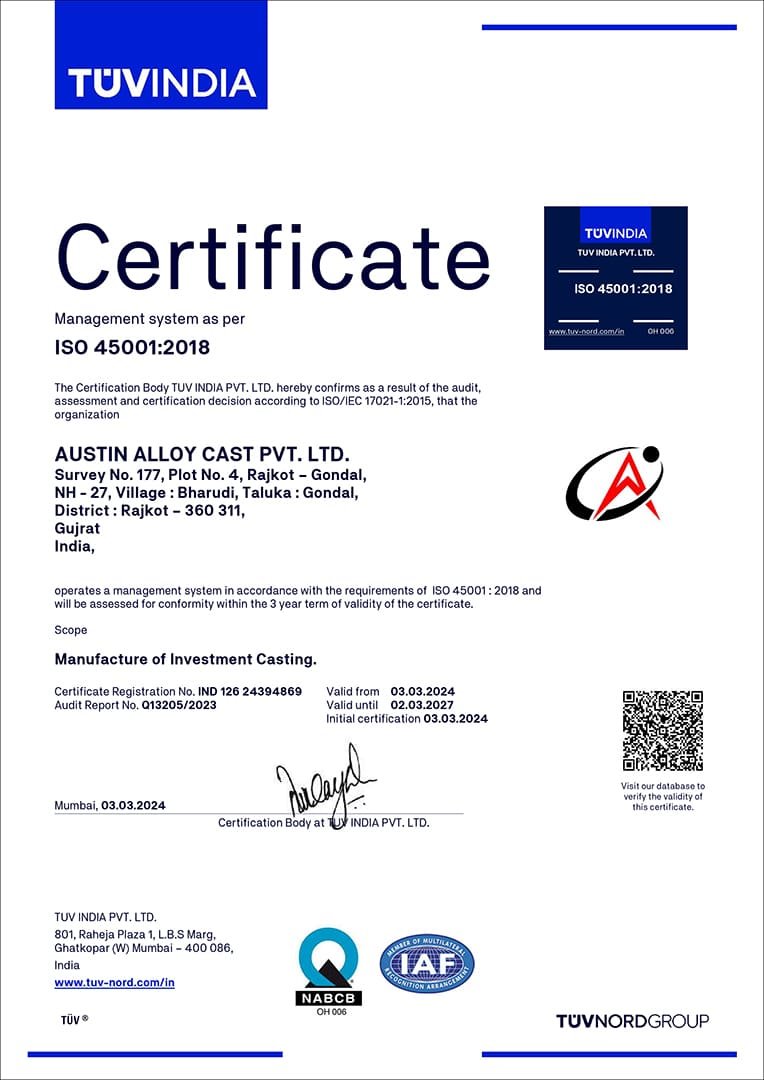
Environmental and occupational health and safety standards can feel far from casting performance, but they increasingly influence sourcing decisions. ISO 14001:2015 focuses on environmental management, while ISO 45001:2018 covers occupational health and safety systems.

At Austin, these certifications indicate that:

  • Environmental impacts (waste, emissions, resource use) are monitored and controlled, supported by the use of 1.5 MW of solar power to run operations.
  • Workplace risks are systematically assessed and mitigated, helping maintain a stable, experienced workforce instead of constant disruption.

For OEM buyers under ESG, CBAM, or corporate sustainability targets, partnering with a foundry that already operates under ISO 14001 and ISO 45001 makes reporting and compliance much easier.

PED 2014/68/EU & UKCA – Pressure and regulatory confidence

If your castings end up in pressure bearing equipment sold into Europe or the UK, PED and UKCA are not optional. PED 2014/68/EU deals with pressure equipment placed on the EU market, while UKCA performs a similar role post Brexit for Great Britain.

What this means in practice at Austin Alloy Cast:

  • Material, production, and test controls meet the requirements for pressure retaining components, including traceability, documentation, and NDT where specified.
  • Audited systems are in place to support CE/UKCA marking on final assemblies by OEM customers, without gaps in the casting portion of the supply chain.

For OEMs in valves, pumps, and other pressure equipment sectors, buying castings from a PED and UKCA approved foundry significantly reduces regulatory risk downstream.

IBR, NORSOK, and marine approvals – Signalling application level robustness

Beyond generic quality and EHS standards, Austin carries a set of sector specific approvals that speak directly to application severity:

  • Indian Boiler Regulations (IBR 1950): Demonstrates compliance with stringent requirements for boiler and pressure parts in the Indian market.
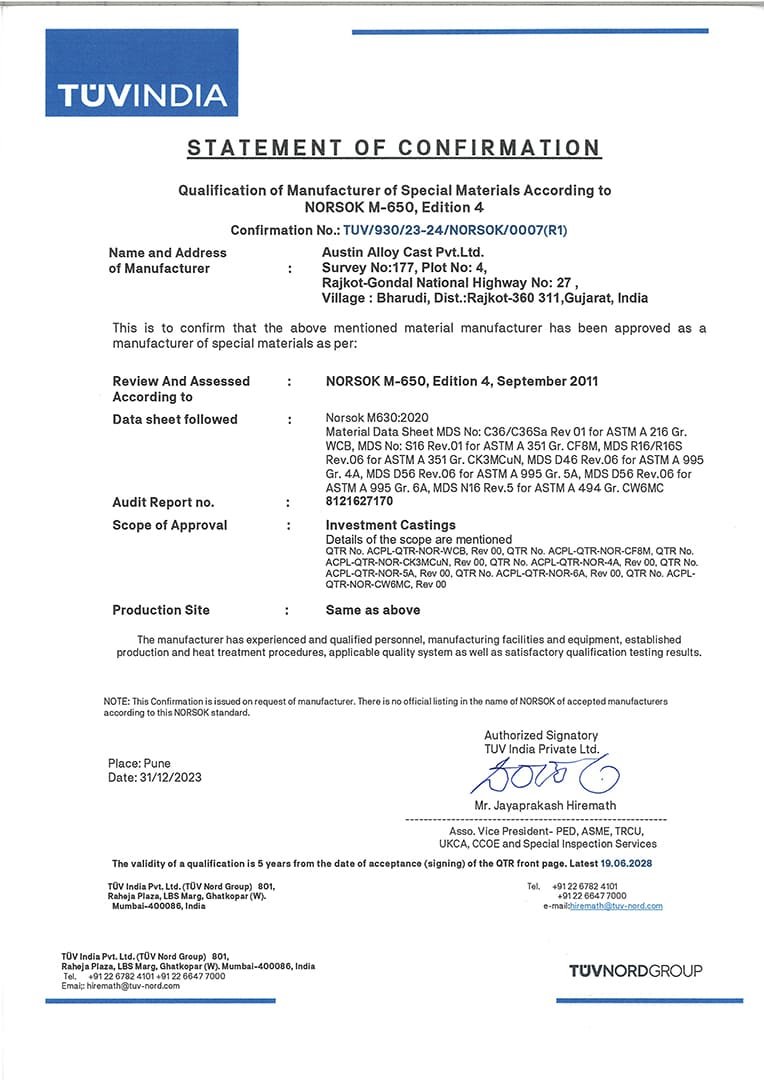
  • NORSOK M‑630 Ed. 6: A critical standard for materials and MPS (manufacturing procedure specification) in the oil & gas sector, especially for North Sea style conditions.
  • Marine approvals from DNV, ABS, Lloyd’s Register, and BV: Indicate that materials, processes, and inspection practices meet the expectations of global marine classification societies.
  • RINA Marine Approval:
    RINA certification confirms that Austin’s investment casting processes, materials, and inspection systems meet stringent marine-class requirements for safety critical applications. Austin is only the 6th foundry group in India to receive RINA Marine approval and notably, the only pure-play Investment Casting company in the country with this accreditation underscoring its capability to serve high-severity global marine OEM programs.

For OEM buyers, these certificates are strong signals that the foundry has been tested against demanding, safety critical applications, not just general engineering jobs.

NDT capability – The “unseen” part of certification 

Certifications are only as strong as the inspection backbone behind them. At Austin Alloy Cast, that backbone is visible in the non destructive testing (NDT) and lab infrastructure:

  • 100% dye penetrant testing for surface crack detection, run under EN 1371‑1 and ASME Section V Article 6 & 24.
  • 100% magnetic particle testing for ferromagnetic components, to EN 1369 and ASME Section V Article 7 & 25.
  • Radiography (X‑ray) using Ir‑192 and Co‑60 sources, with separate facilities, following EN 12681 and ASME Section V Article 2 & 22.
  • Ultrasonic testing capability and a spectrometer covering Fe and Ni based alloys with 42 elements, including nitrogen, supported by CRM samples for different steel families.

For OEMs, this means internal soundness and chemistry are verified against recognised procedures, not ad hoc methods and that claims made on certificates are backed by real, repeatable testing.

WPS approvals – Controlling weld repairs instead of hiding them

Most complex castings need some level of weld repair, especially for high integrity applications. The key question is not “Is there weld?” but “How is weld managed?” Austin’s WPS (Welding Procedure Specification) approvals show that welding is controlled, qualified, and documented, not improvised.

This gives buyers confidence that:

  • Repairs are done within approved limits and methods, preserving mechanical properties and integrity.
  • Welded zones are inspected appropriately, fitting into the wider NDT plan.

For critical components, controlled weld practice can be the difference between a stable casting and a hidden failure point.

How OEM buyers should read certifications in real life

So, what should you actually do with all this as an OEM buyer? Instead of just collecting certificate PDFs, use them to frame better questions and expectations:

  • Match your application to the foundry’s approvals – pressure? marine? offshore? boiler? Choose suppliers whose certification profile aligns with your end use.
  • Ask how each certificate translates into day to day practice – for example, “How does NORSOK M‑630 change your material control and testing for our parts?”
  • Use certifications to support dual sourcing and risk assessments – a foundry like Austin, with ISO, PED, UKCA, IBR, NORSOK, and marine approvals, offers a more robust base for high consequence parts.

At Austin Alloy Cast, certifications are not just badges; they are the visible tip of a deep system of control, testing, and accountability. For OEM buyers, understanding what they actually mean turns a stack of documents into a practical, confidence building tool for safer, more reliable sourcing.