15 Oct 2026

BLOG
Industrial Casting Trends Across Global Manufacturing Sectors
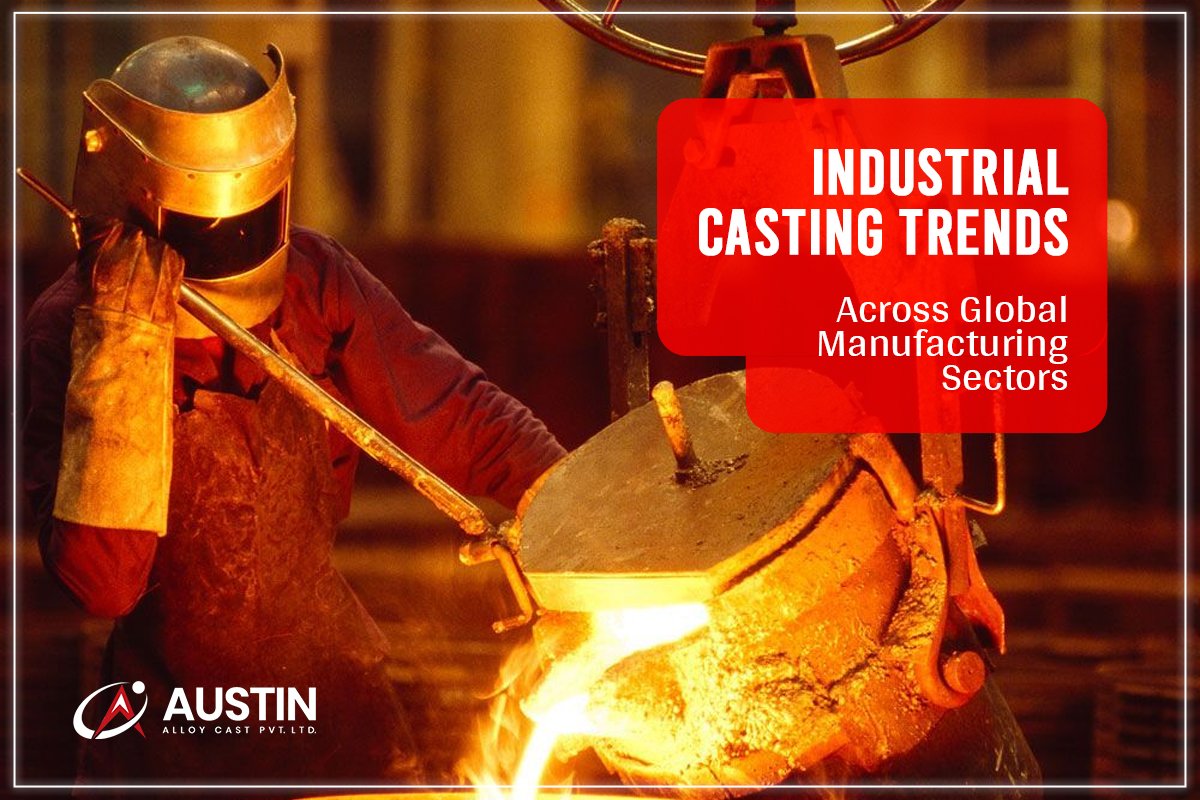
Industrial casting remains a backbone of modern manufacturing, forming critical components for everything from heavy machinery and power generation to aerospace, automotive, and infrastructure. As global industries pursue efficiency, sustainability, and performance, the way industrial casting is designed, produced, and integrated into supply chains is evolving rapidly. At Austin Alloy Cast, these shifts are not just observed, they are actively shaped through innovation in materials, processes, and digital integration.
Growth and diversification of the industrial casting market
Global industrial casting and metal casting markets are on a clear growth trajectory, underpinned by rising demand for durable, high strength components. The metal casting market is projected to expand from around USD 161 billion in 2025 to over USD 260 billion by 2035, driven by industrial machinery, infrastructure projects, and advanced manufacturing sectors. Within this, industrial application castings account for a large share, as construction equipment, agricultural machinery, and industrial automation systems rely heavily on robust cast parts such as housings, frames, and structural components.
At the same time, specialty processes such as investment casting and precision casting are gaining traction, especially in aerospace, energy, and medical grade equipment manufacturing. These segments demand near net shape geometries, tight tolerances, and advanced alloys, pushing foundries toward higher value, lower volume, and more technically complex work.
Lightweighting and advanced alloys
One of the most visible trends across Industrial Casting is the push toward lightweight yet high performance components. Automotive, and new energy vehicle sectors, in particular, are using aluminium and high strength alloys to reduce weight without sacrificing structural integrity. In parallel, manufacturers are adopting nickel, cobalt, and titanium based superalloys for high temperature and high stress environments, such as turbine blades, exhaust systems, and energy sector components.
At Austin Alloy Cast, this means constant evaluation of new alloy compositions and casting techniques that combine strength, corrosion resistance, and dimensional stability. The result is industrial castings that are lighter, longer lasting, and better suited to the performance demands of modern machinery and equipment.
Digitalization, automation, and smart foundries
The second major trend reshaping industrial casting is the widespread adoption of digital tools and automation. AI driven process optimization, real time monitoring, and predictive maintenance systems are now common in leading foundries, enabling tighter control over melt chemistry, pouring temperatures, and solidification behavior. Robotics and automated handling systems reduce human error, improve repeatability, and enhance safety in high temperature environments.
Simulation software and digital twins are also transforming design for casting, allowing engineers to predict shrinkage, defects, and stress patterns before a single mold is poured. At Austin Alloy Cast, such technologies are leveraged to optimize gating, feeding, and heat treatment strategies, improving yield rates, reducing scrap, and shortening lead times for industrial sector customers.
Sustainability and green manufacturing
Sustainability is no longer a side project but a core requirement in industrial casting. Foundries are investing in energy efficient melting technologies, low emission binders, and closed loop recycling of scrap and sand. The use of recycled aluminium and other secondary metals is growing, helping manufacturers reduce both carbon footprint and raw material costs.
In many regions, regulatory pressure and ESG expectations are accelerating this shift. At Austin Alloy Cast, eco conscious practices are integrated into the value chain, from responsible material sourcing and energy conscious melting practices to optimized casting designs that minimize excess material and machining. This supports customers who must meet increasingly stringent environmental and safety standards across global markets.
Global value chains and regional specialization
Globally, the industrial casting landscape is becoming more regionally stratified, with Asia Pacific emerging as a dominant hub due to its deep foundry infrastructure and concentrated automotive and industrial equipment manufacturing. At the same time, North American and European markets are focusing on high value, complex castings that support aerospace, defense, and energy transition projects.
This creates a strong demand for global supply chain partners capable of delivering precision cast components that meet stringent international standards. Austin Alloy Cast positions itself as such a partner, offering industrial grade casting solutions that combine material expertise, process control, and global ready quality systems to serve OEMs across multiple sectors.
What this means for industrial manufacturers
For industrial manufacturers, these trends translate into several practical implications:
- Greater emphasis on material selection tailored to service life, temperature, and load conditions.
- Shorter lead times and higher first time quality rates through digital process control and simulation.
- Stronger sustainability credentials via energy efficient casting and increased use of recycled materials.
Austin Alloy Cast works with OEMs and industrial equipment builders to align casting strategies with these global trends, ensuring that every component whether in a pump, valve, gearbox, or power generation unit delivers the performance, reliability, and efficiency required in today’s competitive markets.
To have a glimpse at our world class facility and products, visit us at www.austinalloycast.com.
For any queries or details contact us at info@austinalloycast.com.
Recent Posts