24 Sep 2026

BLOG
Understanding Nickel-Based Alloys in Investment Casting Applications
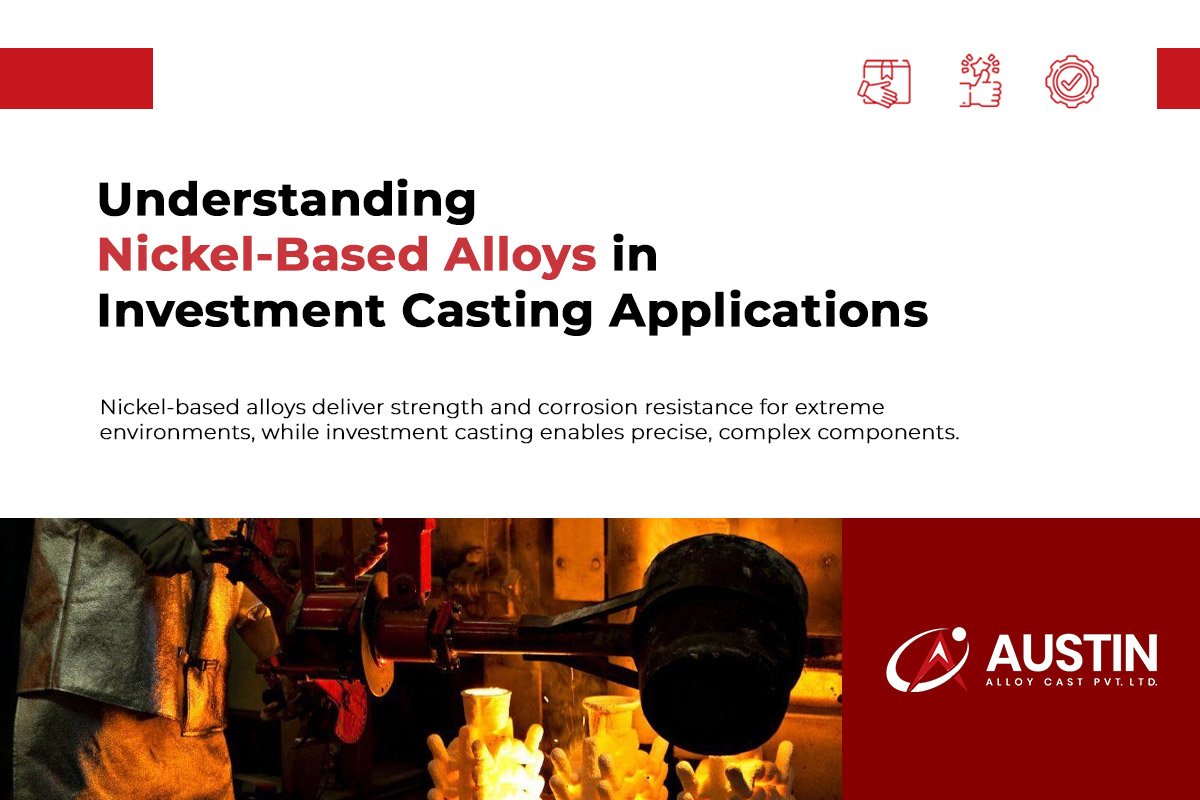
When a component has to survive inside, a chemical reactor, or a subsea pipeline, “strong enough” is not the standard; it has to hold its shape, its strength, and its surface integrity while everything around it tries to corrode, oxidize, or creep it out of tolerance. This is the world nickel-based alloys were built for, and it’s also the world where investment casting earns its keep. At Austin Alloy Cast, we work with these alloys regularly, and this post walks through what makes them behave the way they do, which grades are actually used in practice, and why the investment casting process suits them so well.
Why Nickel Is the Base Metal of Choice for Extreme Environments
Nickel-based alloys are built around a nickel matrix, typically over 50% nickel by weight, combined with elements like chromium, molybdenum, cobalt, iron, aluminum, titanium, and niobium. Each addition does specific work: chromium builds a protective oxide layer that resists oxidation and corrosion, molybdenum and tungsten add solid-solution strength and pitting resistance.
Most nickel-based alloys solidify into an austenitic (face-centered cubic) structure, which is inherently tough and ductile even at low temperatures, a real advantage over the alternatives in many industrial settings. This structure, combined with the alloying strategy above, is what lets nickel alloys operate reliably in the 650°C to 1000°C range, and in some grades, resist degradation even closer to their melting point.
Because of this combination of properties, nickel-based alloys are generally grouped by the job they’re optimized for:
- Heat-resistant grades — built to resist oxidation, creep, and thermal fatigue at sustained high temperature
- Corrosion-resistant grades — built to survive acids, chlorides, and marine or chemical process environments
- Precipitation-hardened superalloys — built for maximum mechanical strength at elevated temperature
- Wear-resistant and precision grades — used where dimensional stability or surface durability matters more than raw strength
The Grades That Actually Show Up on Foundry Floors
A handful of nickel alloy families account for the overwhelming majority of investment-cast nickel components in industry:
Inconel 625 is a nickel-chromium-molybdenum alloy (minimum ~58% nickel) that relies on solid-solution strengthening rather than heat treatment. It resists oxidation up to roughly 980°C and stands out for near-complete resistance to chloride-induced stress corrosion cracking, along with strong resistance to nitric, phosphoric, sulfuric, and hydrochloric acid environments. In the annealed condition, it typically delivers tensile strength in the 830–930 MPa range with elongation as high as 45–60%, which is exceptional ductility for an alloy this corrosion-resistant. This combination is why 625 dominates in marine hardware, seawater valves, submarine and naval propulsion parts, and chemical processing components.
Inconel 718 is the workhorse of the aerospace superalloy world; it’s reported to account for a very large share of global superalloy tonnage, largely because of its balance of cost, weldability, and high-temperature strength. Unlike 625, Inconel 718 is precipitation-hardened: niobium and titanium form γ’ and γ” strengthening phases during aging heat treatment, pushing aged tensile strength up to roughly 1,240–1,550 MPa and yield strength above 1,000 MPa nearly double that of annealed 625. Its practical service ceiling is lower, however, generally cited around 649–704°C, because the γ” phase overages and creep resistance drops sharply above that range. It’s the standard choice for jet engine components, gas turbine hardware, and other rotating parts where fatigue life and high-stress performance matter more than corrosion margin.
Hastelloy alloys (C-276, C-22, C-2000, and related grades) are nickel-molybdenum-chromium alloys purpose-built for aggressive chemical environments hot chlorides, sulfuric and hydrochloric acid service, and other conditions that would pit or crack lesser alloys. These are common in chemical processing and pollution-control equipment where corrosion resistance is the primary design driver.
Monel 400 and related nickel-copper alloys offer strong resistance to seawater and reducing acids and remain a standard choice in marine hardware and certain chemical processing applications where copper-nickel chemistry gives an edge over straight nickel-chromium systems.
Why Investment Casting Is the Right Process for These Alloys
Nickel superalloys are notoriously difficult to machine the same high-temperature strength and work-hardening behavior that make them valuable and also make them slow and tool-intensive to cut from bar stock. Investment (lost-wax) casting sidesteps much of that problem by producing a near-net-shape part directly from molten metal, which is precisely why it’s the dominant production route for complex nickel alloy components rather than an alternative to machining.
A few reasons this pairing works so well in practice:
- Complex geometry without complex machining. Turbine blades, impellers, valve bodies, and manifold components often have internal passages, thin walls, or curved surfaces that would be extremely costly or impossible to machine from solid stock. Investment casting produces these shapes directly.
- Reduced or eliminated secondary machining. Fine-grain investment casting, particularly with silica-sol shell processes, can reach tight dimensional and geometric tolerances straight out of the mold, cutting down the amount of hard-alloy machining required afterward.
- Metallurgical consistency. Because the process controls solidification rate and mold environment closely, foundries can manage grain structure and minimize segregation, an important consideration for cast nickel superalloys, where issues like niobium segregation and Laves phase formation have historically been a challenge that heat treatment and process control are used to address.
What This Means for Component Selection
Choosing a nickel-based alloy for a cast component really comes down to three questions: What’s the operating temperature? What’s the corrosive environment? And how much mechanical load and fatigue cycling will the part see? A part destined for a jet engine hot section leans toward Inconel 718 or similar precipitation-hardened superalloys. A part destined for seawater or acid service leans toward Inconel 625, Hastelloy, or Monel. Getting this match right and casting to the correct AMS or equivalent specification rather than a generic “nickel alloy” is what determines whether a component lasts its intended service life or fails early.
At Austin Alloy Cast, this is the kind of alloy selection and process discipline we apply on every nickel-based investment casting project matching the right grade, the right melting practice, and the right quality control to the environment the part will actually operate in.
To have a glimpse at our world class facility and products, visit us at www.austinalloycast.com.
For any queries or details contact us at info@austinalloycast.com.
Recent Posts