15 Oct 2026

BLOG
NORSOK Standards for Superior Steel Castings
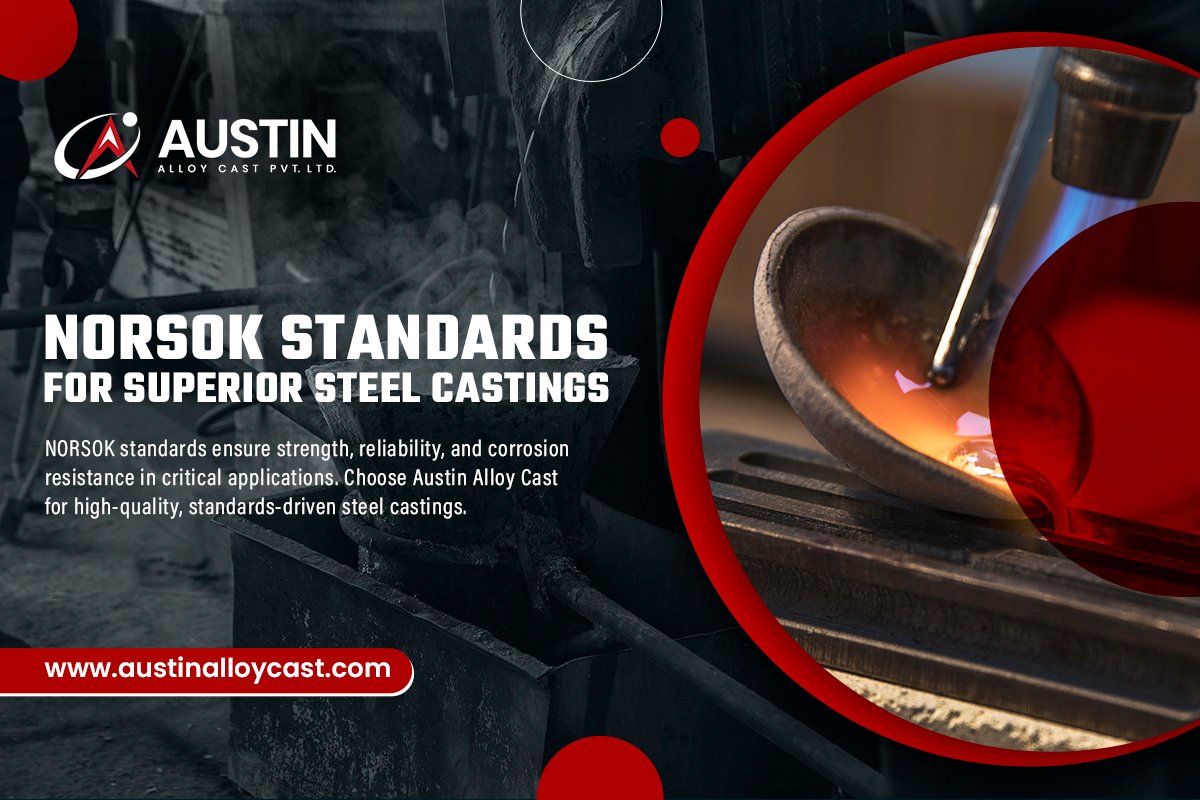
In the demanding world of oil, gas, and offshore engineering, there is no room for compromise. Components must survive corrosive seawater, extreme pressures, and freezing temperatures for decades without failure. This is precisely why the NORSOK standards have become a global benchmark for quality. For any steel casting destined for critical petroleum applications, NORSOK compliance is often the dividing line between a part that performs reliably and one that puts safety and investment at risk. At Austin Alloy Cast, we understand how vital these standards are, and we recognise why so many engineers insist on NORSOK qualified castings.
What Are NORSOK Standards?
NORSOK is a set of standards developed by the Norwegian petroleum industry, administered and published by Standards Norway. The name originates from the Norwegian “Norsk Sokkels Konkurranseposisjon,” and the standards were created with a clear mission: to ensure adequate safety, value creation, and cost effectiveness for petroleum operations. They were born out of necessity, shaped by the punishing conditions of North Sea offshore drilling, where equipment faces some of the harshest environments on Earth.
While NORSOK was designed for the Norwegian continental shelf, its rigour has earned worldwide respect. Today, manufacturers and buyers operating in far gentler environments adopt NORSOK requirements simply because they represent a gold standard of material integrity and traceability.
Why NORSOK Matters for Steel Castings
Steel castings used in offshore valves, pumps, flanges, manifolds, and structural components must resist pitting, crevice corrosion, and stress in chloride rich seawater. NORSOK addresses these challenges head on by setting precise requirements for chemistry, mechanical properties, heat treatment, corrosion resistance, and testing. This is especially important for high performance alloys such as duplex and super duplex stainless steel, as well as high alloy austenitic grades, which are favoured for their exceptional strength and corrosion resistance.
Without a recognised framework, buyers would have to trust each foundry’s word that a casting meets specification. NORSOK removes that uncertainty by demanding documented, verifiable proof at every stage.
The Key NORSOK Standards for Castings
Several NORSOK documents are particularly relevant to steel casting manufacturers and buyers.
NORSOK M-630 is a collection of Material Data Sheets (MDS) that define the detailed requirements for specific material grades and product forms, including castings. Each data sheet specifies the steel making process, chemical composition limits, heat treatment, corrosion testing, marking, and certification requirements. For example, separate data sheets cover austenitic stainless steel castings and duplex stainless steel castings, leaving no ambiguity about what an acceptable part looks like.
NORSOK M-650, titled “Qualification of Manufacturers of Special Materials,” is arguably the most demanding. Rather than testing only the final product, it verifies that a manufacturer actually possesses the equipment, procedures, and competence to consistently produce material with acceptable properties. It applies mainly to duplex and high alloy austenitic stainless steel, and also to castings made of nickel based alloys, titanium, and titanium alloys.
NORSOK M-001 provides overarching guidance on materials selection, helping engineers choose the right alloy for a given service environment, while NORSOK M-122 addresses the qualification of foundries and delivery requirements for cast structural steel used offshore.
What It Takes to Achieve NORSOK Qualification
Earning NORSOK M-650 qualification is no small feat, and that is exactly the point. The standard is route specific, meaning a manufacturer must prove it can repeatedly produce a particular alloy, through a particular production route, in a particular product form and thickness. Re qualification is required for any significant change in variables such as grade of material, melting equipment, heat treatment process or even plant location.
Heat treatment receives heavy emphasis. Furnaces must be calibrated and proven for uniformity and consistency, with full documentation of loading, temperature measurement using contact thermocouples, soak times, and quenching processes. The qualification also demands extensive destructive and non destructive testing on samples representative of the actual heat and heat treatment batch. Crucially, the testing laboratories must operate a quality system in line with ISO 17025 and hold national accreditation.
Once complete, the manufacturer and purchasing company sign a Qualification Test Record (QTR), typically valid for a defined period before requalification is needed. This is a strict, audited process that gives buyers real confidence in NORSOK qualified castings.
The Benefits of Choosing NORSOK Compliant Castings
For end users, the advantages are substantial. NORSOK compliance guarantees rigorous material traceability, so the origin and properties of every casting can be documented and verified. It offers excellent corrosion resistance in harsh marine and chemical environments, thereby reducing the risk of premature failure. It delivers consistency and repeatability, ensuring that every part in a batch meets the same exacting requirements. And ultimately, it lowers the total cost of ownership by minimising downtime, replacements, and safety incidents over the life of the asset.
In short, a NORSOK qualified casting is not just a part that passed a test. It is the product of a fully audited, controlled manufacturing system designed for the most unforgiving applications imaginable.
Partner With Austin Alloy Cast for Quality You Can Trust
Meeting standards as demanding as NORSOK requires an experienced manufacturer with a dedicated quality and engineering team, the right equipment, and a highly skilled workforce. At Austin Alloy Cast, quality is the foundation of everything we do. Operating one of the largest investment casting facilities in India, we specialise in alloy steel and stainless steel castings produced to international standards and certifications. Because our castings go into critical applications, we treat every customer’s reputation as our own, backing each component with consistent quality and reliable delivery.
Whether you need duplex stainless steel castings for offshore service or precision components for other high integrity applications, our technically sound team is ready to support your project from sample development through to final delivery.
Final Thoughts
NORSOK standards exist because failure is not an option in the offshore and petroleum industries. By defining strict requirements for chemistry, heat treatment, testing, and manufacturer qualification, they ensure that steel castings deliver superior strength, corrosion resistance, and reliability where it matters most.
If you are sourcing high quality, standards driven steel castings, partner with Austin Alloy Cast and join the Austin family. Contact us today to discuss your requirements.
To have a glimpse at our world class facility and products, visit us at www.austinalloycast.com.
For any queries or details contact us at info@austinalloycast.com.
Recent Posts