26 Mar 2026

BLOG
Understanding Foundry Certifications: What They Actually Mean for OEM Buyers
When you are under pressure to launch a new programme or keep an existing line running, it is easy to treat foundry certificates as a checkbox, “ISO? PED? Marine society approvals? Good, move on.” In reality, those certificates hide years of discipline, audits, and process control that directly affect whether the castings on your line behave like reliable components or recurring problems. This is exactly why, at Austin Alloy Cast, we take certifications seriously and why OEM buyers should too.
Why certifications matter beyond logos on a website
From an OEM perspective, certifications are really a shortcut to one question: “Has this foundry proven it can run a stable, audited system that protects my brand?” A certificate does not pour metal, but it forces the foundry to document, monitor, and improve how it works every single day.
For buyers, that translates to:
- Lower risk of random quality escapes because processes are defined, followed, and verified.
- Easier internal approvals, since certified suppliers align with your own quality, safety, and environmental policies.
- Smoother customer and regulatory audits, where third party credentials support your sourcing decisions.
In other words, certifications are not marketing; they are part of your risk management toolkit.
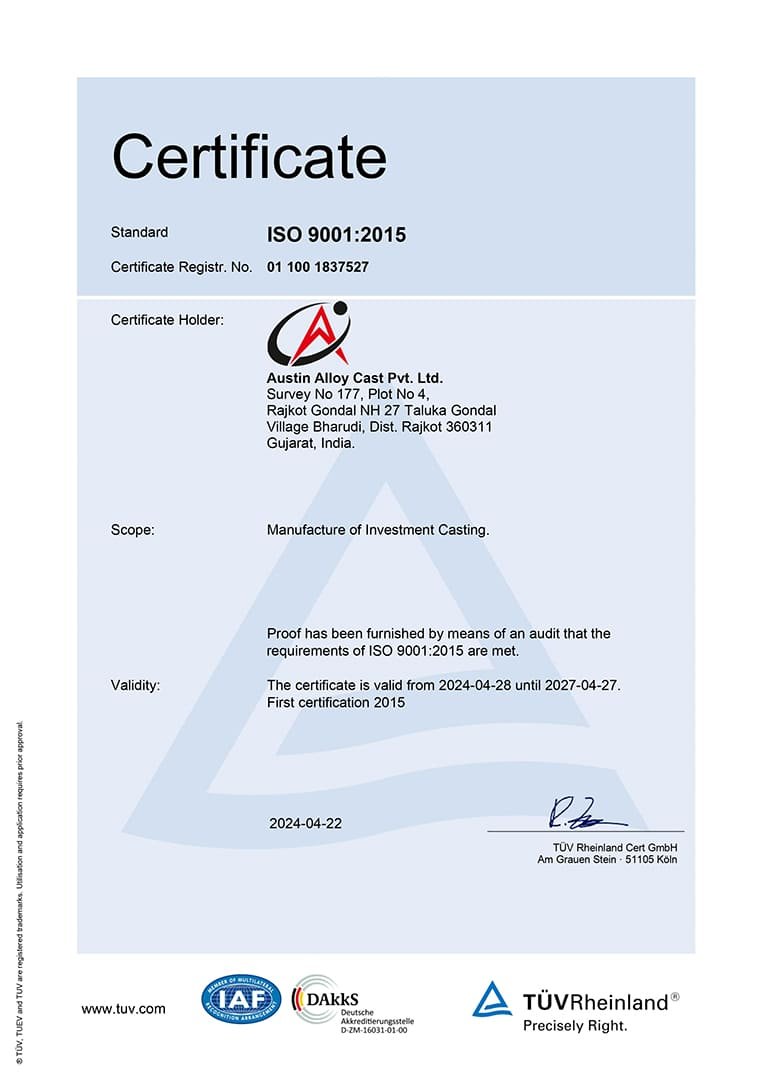
ISO 9001:2015 – What it really tells you
Almost every serious industrial supplier claims ISO 9001, but buyers often underestimate what it actually demands. ISO 9001:2015 is a quality management standard that requires the foundry to control everything from contract review and design support to production, inspection, calibration, and corrective actions.
At Austin Alloy Cast, ISO 9001:2015 means:
- Every order starts with a clear review of requirements and feasibility, rather than assumptions on the shop floor.
- Processes are documented and audited, so critical steps wax injection, shell building, pouring, heat treatment, NDT follow agreed methods, not individual habits.
- Non conformances trigger root cause analysis and corrective actions, creating learning loops instead of repeated problems.
For OEMs, this reduces the “surprise factor” and builds confidence that issues will be handled systematically, not just patched.
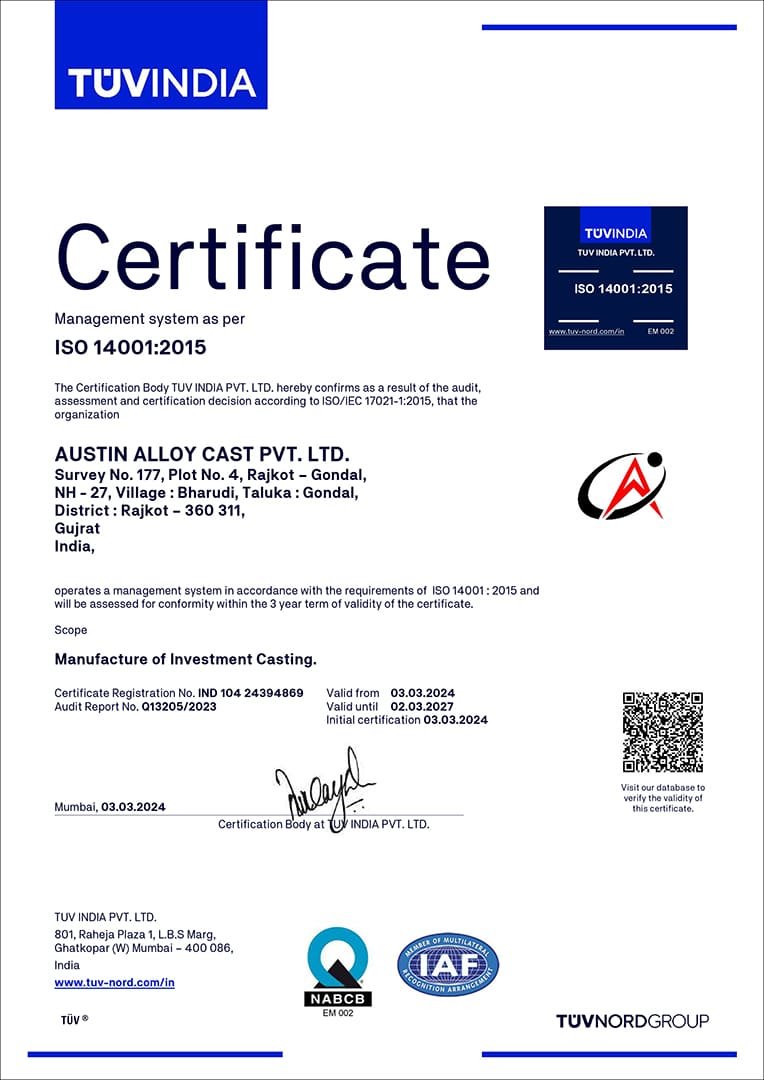
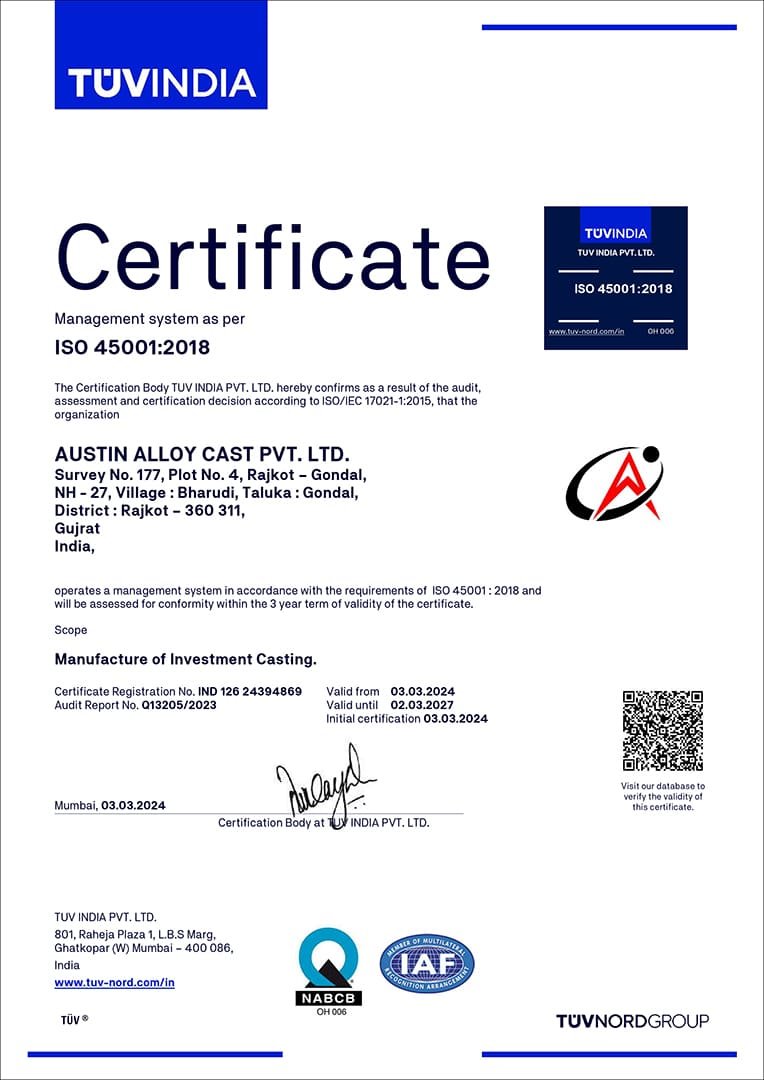
ISO 14001 & ISO 45001 – Why EHS certifications matter to buyers
Environmental and occupational health and safety standards can feel far from casting performance, but they increasingly influence sourcing decisions. ISO 14001:2015 focuses on environmental management, while ISO 45001:2018 covers occupational health and safety systems.
At Austin, these certifications indicate that:
- Environmental impacts (waste, emissions, resource use) are monitored and controlled, supported by the use of 1.5 MW of solar power to run operations.
- Workplace risks are systematically assessed and mitigated, helping maintain a stable, experienced workforce instead of constant disruption.
For OEM buyers under ESG, CBAM, or corporate sustainability targets, partnering with a foundry that already operates under ISO 14001 and ISO 45001 makes reporting and compliance much easier.
PED 2014/68/EU & UKCA – Pressure and regulatory confidence
If your castings end up in pressure bearing equipment sold into Europe or the UK, PED and UKCA are not optional. PED 2014/68/EU deals with pressure equipment placed on the EU market, while UKCA performs a similar role post Brexit for Great Britain.
What this means in practice at Austin Alloy Cast:
- Material, production, and test controls meet the requirements for pressure retaining components, including traceability, documentation, and NDT where specified.
- Audited systems are in place to support CE/UKCA marking on final assemblies by OEM customers, without gaps in the casting portion of the supply chain.
For OEMs in valves, pumps, and other pressure equipment sectors, buying castings from a PED and UKCA approved foundry significantly reduces regulatory risk downstream.
IBR, NORSOK, and marine approvals – Signalling application level robustness
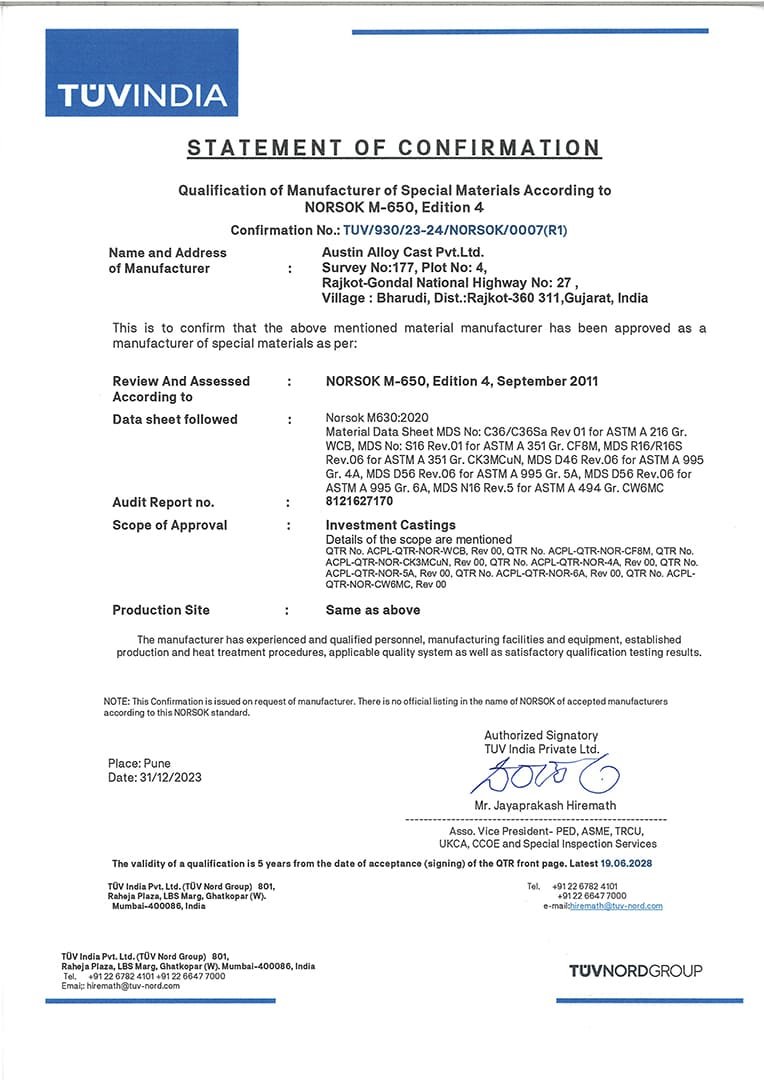
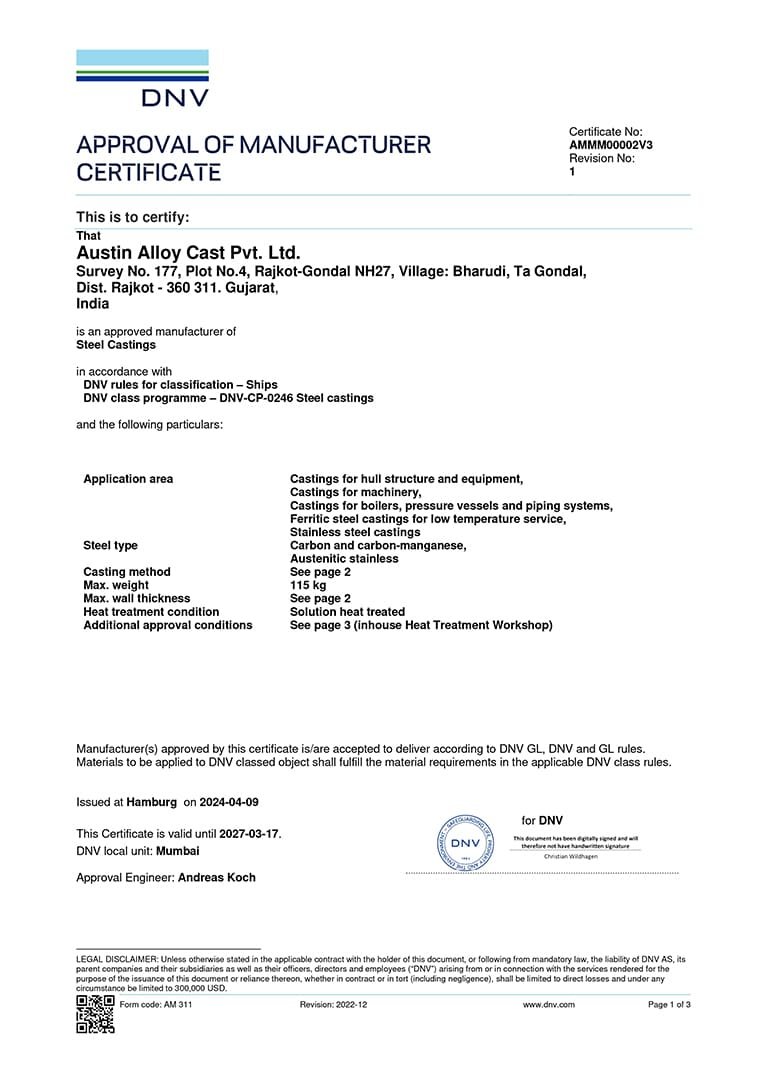
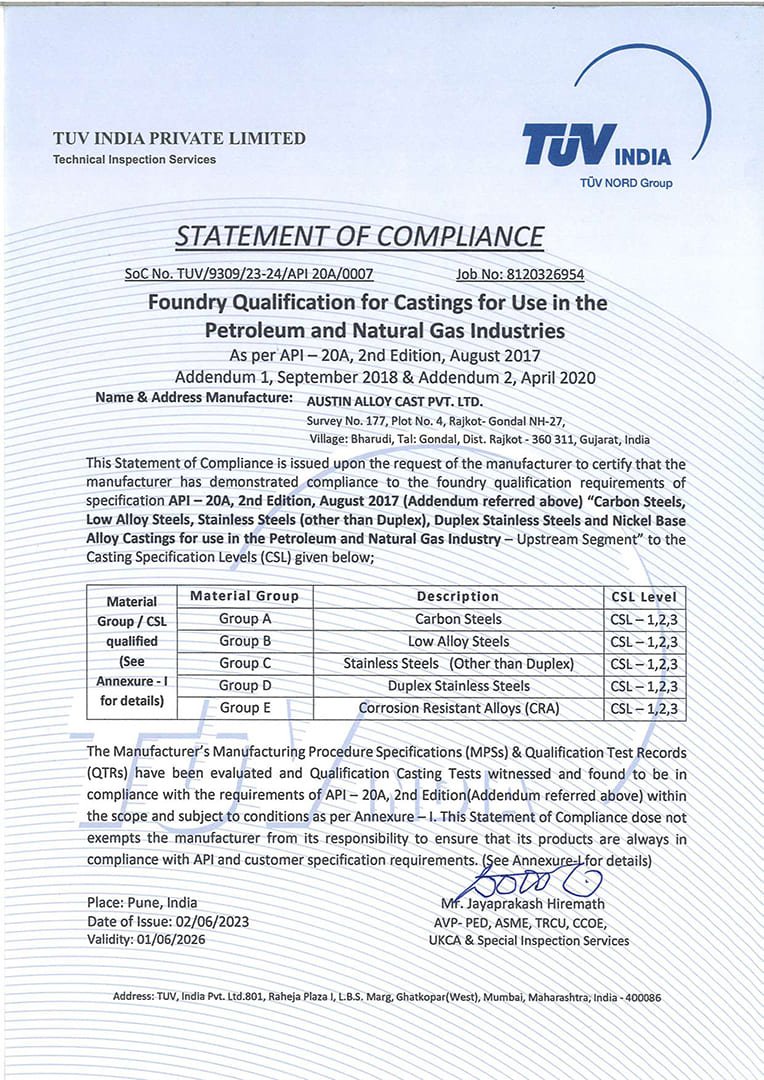
Beyond generic quality and EHS standards, Austin carries a set of sector specific approvals that speak directly to application severity:
- Indian Boiler Regulations (IBR 1950): Demonstrates compliance with stringent requirements for boiler and pressure parts in the Indian market.
- NORSOK M‑630 Ed. 6: A critical standard for materials and MPS (manufacturing procedure specification) in the oil & gas sector, especially for North Sea style conditions.
- Marine approvals from DNV, ABS, Lloyd’s Register, and BV: Indicate that materials, processes, and inspection practices meet the expectations of global marine classification societies.
- RINA Marine Approval:
RINA certification confirms that Austin’s investment casting processes, materials, and inspection systems meet stringent marine-class requirements for safety critical applications. Austin is only the 6th foundry group in India to receive RINA Marine approval and notably, the only pure-play Investment Casting company in the country with this accreditation underscoring its capability to serve high-severity global marine OEM programs.
For OEM buyers, these certificates are strong signals that the foundry has been tested against demanding, safety critical applications, not just general engineering jobs.
NDT capability – The “unseen” part of certification
Certifications are only as strong as the inspection backbone behind them. At Austin Alloy Cast, that backbone is visible in the non destructive testing (NDT) and lab infrastructure:
- 100% dye penetrant testing for surface crack detection, run under EN 1371‑1 and ASME Section V Article 6 & 24.
- 100% magnetic particle testing for ferromagnetic components, to EN 1369 and ASME Section V Article 7 & 25.
- Radiography (X‑ray) using Ir‑192 and Co‑60 sources, with separate facilities, following EN 12681 and ASME Section V Article 2 & 22.
- Ultrasonic testing capability and a spectrometer covering Fe and Ni based alloys with 42 elements, including nitrogen, supported by CRM samples for different steel families.
For OEMs, this means internal soundness and chemistry are verified against recognised procedures, not ad hoc methods and that claims made on certificates are backed by real, repeatable testing.
WPS approvals – Controlling weld repairs instead of hiding them
Most complex castings need some level of weld repair, especially for high integrity applications. The key question is not “Is there weld?” but “How is weld managed?” Austin’s WPS (Welding Procedure Specification) approvals show that welding is controlled, qualified, and documented, not improvised.
This gives buyers confidence that:
- Repairs are done within approved limits and methods, preserving mechanical properties and integrity.
- Welded zones are inspected appropriately, fitting into the wider NDT plan.
For critical components, controlled weld practice can be the difference between a stable casting and a hidden failure point.
How OEM buyers should read certifications in real life
So, what should you actually do with all this as an OEM buyer? Instead of just collecting certificate PDFs, use them to frame better questions and expectations:
- Match your application to the foundry’s approvals – pressure? marine? offshore? boiler? Choose suppliers whose certification profile aligns with your end use.
- Ask how each certificate translates into day to day practice – for example, “How does NORSOK M‑630 change your material control and testing for our parts?”
- Use certifications to support dual sourcing and risk assessments – a foundry like Austin, with ISO, PED, UKCA, IBR, NORSOK, and marine approvals, offers a more robust base for high consequence parts.
At Austin Alloy Cast, certifications are not just badges; they are the visible tip of a deep system of control, testing, and accountability. For OEM buyers, understanding what they actually mean turns a stack of documents into a practical, confidence building tool for safer, more reliable sourcing.
To have a glimpse at our world class facility and products, visit us at www.austinalloycast.com.
For any queries or details contact us at info@austinalloycast.com.
Recent Posts