26 Feb 2026

BLOG
Investment Casting vs Fabrication vs Forging: Cost, Lead Time & Performance Comparison for OEMs
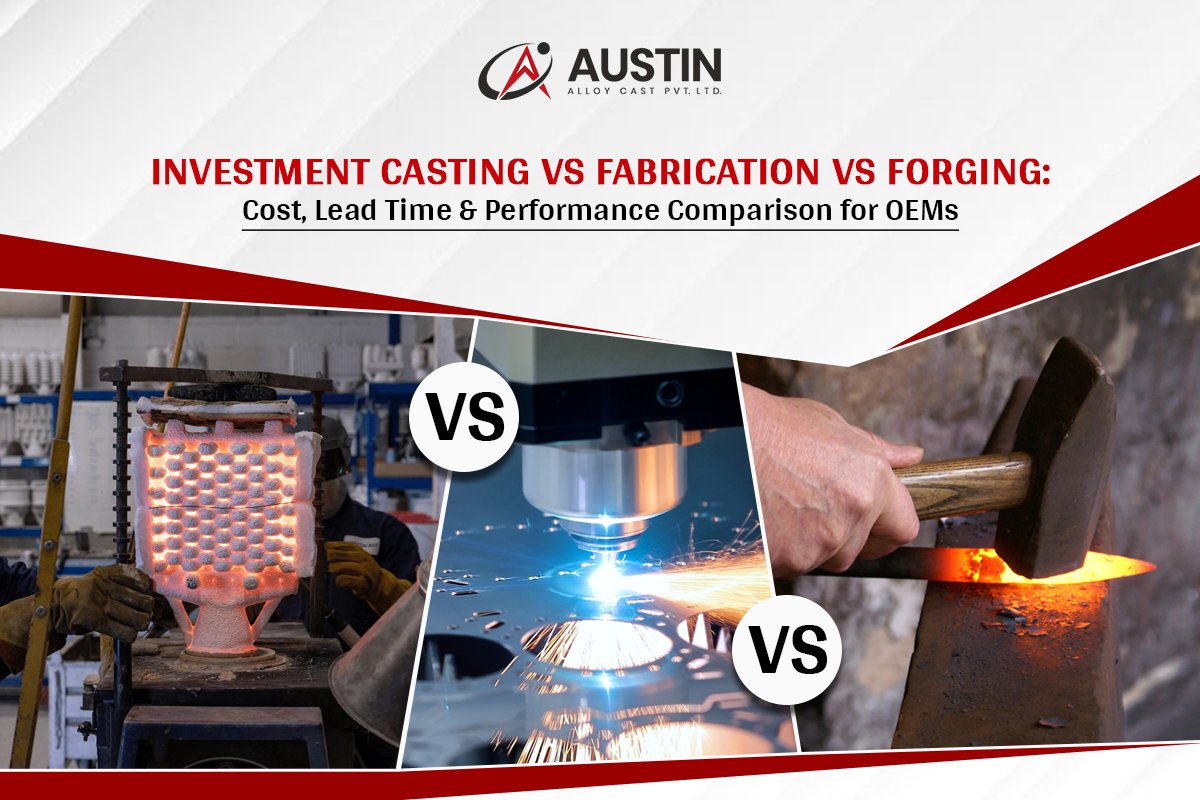
For an OEM, the selection of the right metal manufacturing process is not just a technical decision; it directly impacts product cost, delivery timelines, performance, and long term reliability. Austin Alloy Cast, work closely with OEMs across industries, often see how early process selection influences overall project success. Among the most commonly evaluated processes are investment casting, fabrication, and forging, each with its own strengths, limitations, and ideal use cases.
This comparison becomes particularly relevant at the decision stage, as OEMs must balance design complexity against volume requirements, material performance, and total cost of ownership. This article separates fact from fiction to highlight the real differences between investment casting vs. forging and investment casting vs. fabrication, helping OEMs choose the best metal manufacturing process for their specific application.
Understanding the Three Processes
Before making a comparison for cost, lead time, and performance, each process has to be understood at a basic level.
Certain investment casting processes produce parts by means of a wax pattern, a ceramic coating applied thereto, and then the pouring of molten metal into the cavity. It is a process noted for very good dimensional accuracy and complex shapes.
Fabrication refers to the process that concerns cutting, bending, welding, or assembling a metal plate, bar, or tube to a structure of its final shape. It is typically done with large assemblies or when production volume is low.
The process of forging shapes metal by applying compressive force, normally hammering or pressing, to improve strength and grain structure.
Each of these methods serves a different design and performance need listing them side by side, will make this clearer.
Comparison of Costs Tooling vs Total Manufacturing Cost
Cost is often the first concern when comparing investment casting vs forging or fabrication, but the investment needs to be viewed holistically.
Due to Mold and pattern development, investment casting typically requires higher initial tooling costs. Once this tooling is in place, however, the cost per part becomes highly competitive, mostly for medium to high quantities. In fact, this near net shape capability contributes to reduced machining, material waste, and secondary operations, which in turn reduces the overall cost.
Fabrication typically has lower upfront costs because it does not depend on tooling. This makes it attractive for prototypes or very low production volumes. But as the level of complexity increases, fabrication becomes expensive due to welding labour, inspection requirements, rework, and material waste. Over time, fabricated parts often have higher lifecycle costs.
Most forging involves very expensive dies and equipment, particularly for closed die forging. Although the cost of forged parts can be relatively low in very large quantities, secondary machining is often very extensive. This adds to the cost, particularly for parts with complex geometries.
With investment casting, from a total cost standpoint, it can generally offer the best balance between investment in tooling and long term cost efficiency for OEMs in the production of precision components.
Lead Time Comparison: Speed from Design to Delivery
In fact, lead time is the critical element for production planning and supply chain reliability.
Investment casting requires time to develop tooling, but once approved, it provides consistent and predictable lead times. The process allows multiple components to be cast in a single run, further reducing overall production cycles. Lead times for repeat orders are generally shorter than fabrication and forging.
Fabrication may appear quicker initially because it bypasses tooling, but lead times can extend due to manual processes, welding schedules, quality checks, and rework. Complex fabrication assemblies are often the ones that experience further delays in skilled labour availability.
Forging typically exhibits longer lead times, especially within the stages of tooling and die development. In some cases, limited forging press availability may affect production scheduling. This makes forging less flexible to changes in demand from OEMs.
Investment casting offers a great advantage in regard to lead time consistency for OEMs searching for reliability and scalability.
Performance Comparison
The requirements of performance vary greatly between industries, and herein come the main differences.
The process is well known for excellent mechanical strength due to refined grain flow. Forgings work very well in applications involving high impact or high load. However, generally, such strengths come at the expense of design flexibility and precision.
The quality of the welds plays a great role in fabricated parts. Fabrication works for structural applications, although the welded joints may become stress points, especially under cyclic loads or corrosive environments.
Investment casting shows a balanced performance profile: While it does not always provide the raw impact strength as forging can, it does contribute much better dimensional accuracy and uniformity in material properties, with the ability to integrate multiple features into one component. This reduces weak points and improves overall reliability.
When tight tolerances, smooth surfaces, and consistent performance are required of an OEM, the process of choice is often investment casting.
Design Freedom & Complexity
One of the major deciding factors in selecting the best metal manufacturing process is design flexibility.
The technique of investment casting offers some quite superior geometry: complex shapes, internal passages, thin walls, and fine details unattainable or cumbersome by forging or fabrication. Several parts are often combined into one casting, reducing assembly and improving product reliability.
Fabrication is restricted by limitations in cutting and welding. Complex shapes involve a lot of welds, which increases the chance for inspection and failure. Of the forging processes, it offers the least design flexibility. Design iterations are often not accomplished inexpensively because small changes in geometry result in the need for new dies.
For the more imaginative OEMs looking to shave a few millimetres off their designs, investment casting is clearly the way to go.
Material Versatility
The investment casting technique supports a wide ferrous and non-ferrous alloys range, including stainless steels, alloy steels, duplex steels, nickel based alloys, and cobalt based alloys.
The availability of the required material form limits fabrication, forging limits alloy choices because of forgeability problems.
This flexibility in materials makes investment casting appropriate for use by OEMs operating in oil & gas, medical, food processing, and heavy engineering., Marine Industry, Pulp & Paper Industry.
Choosing the Best Metal Manufacturing Process
There is no one size fits all answer, but when comparing investment casting vs forging and investment casting vs fabrication, some clear patterns do emerge.
Investment casting is best suited for OEMs needing:
- Complex, precision components
- Reduced machining and fewer assembling
High quality productions at scale. Optimized overall cost and lead time. Fabrication was appropriate for large, simple structures or for one off projects, whereas forging remained suitable for applications that required very high strength with simple geometries. At Austin Alloy Cast, OEMs are supported in evaluating these trade offs and selecting the most efficient manufacturing route, based on application, volume, and performance needs. With deep expertise in investment casting, the focus remains reliably and precisely on the delivery of parts that align with real world production and business goals.
To have a glimpse at our world class facility and products, visit us at www.austinalloycast.com.
For any queries or details contact us at info@austinalloycast.com.
Recent Posts