26 Feb 2026

BLOG
How Non-Destructive Testing (NDT) Ensures Casting Integrity
In the realm of precision metal manufacturing, where quality and reliability equal success, Non Destructive Testing (NDT) is crucial to ensuring each component is manufactured according to specifications. As investment casting manufacturer; Austin Alloy Cast Pvt. Ltd., Non Destructive Testing is more than a final check for quality; it is a commitment to quality, safety, and customer satisfaction.
Whether the component is made from stainless steel castings in marine applications or high strength alloy components supplied to energy and engineering customers, casting integrity is paramount. A single defect, even a microscopic one, can reduce casting performance or worse, fail catastrophically. Non Destructive Testing ensures that every casting leaves the foundry with precision and reliability, both uncompromised.
The Importance of Casting Integrity
All castings experience dynamics stresses pumps, valves, turbines, automotive systems; all of them will face dynamic stresses during operation. Any hidden porosity, micro cracks, or inclusions may reduce the casting structural integrity ultimately leading to fatigue failure or leakage. Fogging is insufficient to identify these hidden internal or surface defects.
At Austin Alloy Cast Pvt. Ltd. we strive to achieve “zero defect” castings, our team employs an organized and structured inspection strategy in combination with advanced Non Destructive Testing practices around the production cycle. This ensures every investment casting or stainless steel castings not only ach0ieves dimensional accuracy but passes maximum metallurgical integrity standards.
What is Non Destructive Testing?
Non Destructive Testing (NDT) is a family of scientific methods employed to evaluate materials, components, or assemblies to detect defects or changes in material properties in a manner which does not harm or change the item being tested. In contrast to destructive testing methods such as cutting or breaking a sample, the item can be tested and place into service.
With respect to foundry applications, Non Destructive Testing inspects foundry castings for defects such as cracking, shrinkage, porosity, inclusions, or surface defects to provide assurance of mechanical integrity and reliability.
NDT Methods Commonly Implemented at Austin Alloy Cast
1. Visual Inspection (VI)
Visual inspection is the initial step in any quality assurance program. At Austin Alloy Cast, a certified inspector examines the castings for surface defects, blowholes, or flash. Inspectors use bright light, magnifying glasses, and surface profile gauges to discover some of the smallest defects on surface before succession to advanced testing.
2. Dye Penetrant Testing (DPT)
Dye penetrant testing is a very effective method for assessing surfaces on non magnetic materials such as austenitic stainless steel castings. DPT works using these steps:
- A penetrant, in liquid form, is applied to the surface.
- The penetrant can infiltrate surface breaking defects like cracks or pinholes.
- Once excess penetrant is wiped away, a developer is applied to the surface and it draws the penetrant out to indicate flaws on the surface.
DPT is relatively simplistic, yet it is very effective capable of revealing hairline cracks and other flaws that the naked eye is unable to see.
3. Magnetic Particle Testing (MPT)
The MPT method is used mainly on ferromagnetic alloys but it’s really effective on nonmagnetic alloys. In order to perform the MPT, the component to be inspected is magnetized and fine magnetic particles are applied to the magnetized surface. If a surface or near surface defect is present, it will disrupt the magnetic field in some way which will lead to the collection of the magnetic particles and create a visible indication of the defect.
At Austin Alloy Cast Pvt. Ltd., Magnetic Particle Testing is regularly used on carbon steel and low alloy castings to detect defects like laps, seams, and cracks before machining.
4. Radiographic Testing (RT)
Radiographic Testing, or X ray inspection, is a very reliable method of NDT performed to disclose internal defects. In this technique, X rays or gamma rays are passed through the casting material, and the pattern of radiation on the radiographic film or digital image will indicate whether or not internal defects are present. Commonly detected defects include gas porosity, shrinkage cavities, and the presence of inclusions.
Utilizing the latest state of the art, high resolution radiography systems, Austin Alloy Cast examines the internal integrity of intricate investment castings where high precision and safety are demanded in aerospace, marine, and energy applications.
5. Ultrasonic Testing (UT)
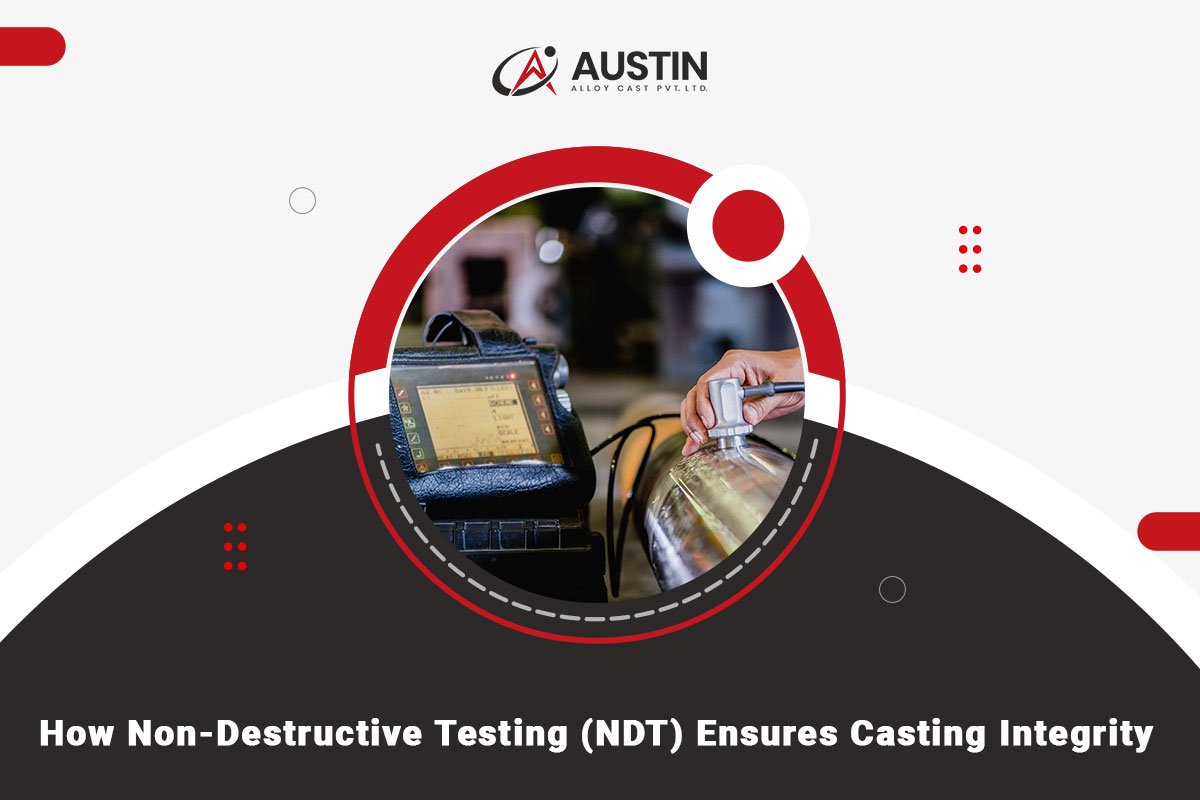
Principle: Ultrasonic Testing (UT) transmits high frequency sound waves into the casting and then analyzes the reflected waves to reveal internal discontinuities and/or changes in material thickness. UT is particularly helpful for large and thick components, where radiography is not practical.
This is the means by which Austin Alloy Cast can ensure that any stainless steel casting or alloy component has no subsurface discontinuities, giving our customer complete confidence in the performance of their product in critical applications.
Integrating Non Destructive Testing into the Manufacturing Process
At Austin Alloy Cast Pvt. Ltd., NDT is not a separate activity but is an integrated part of each and every manufacturing stage:
- Post Moulding: Initial inspection can locate casting flaws prior to machining.
- Heat Treatment: Metallurgical properties and integrity should not be affected.
- Pre Dispatch: A final quality check is done for every component to ensure that the processed components meet the client’s specifications.
This quality loop significantly reduces rework, enhances production efficiency, and builds long term trust with clients in multiple sectors: oil & gas, marine, railway, and defense.
Austin Alloy Cast is distinguished in being continually committed to quality and innovation in the investment castings it manufactures. The NDT team undergoes training and certification to international standards, ensuring consistently high levels of quality traceable in every inspection.
We are certified to meet the requirements of ISO 9001, ISO 14001, and ISO 45001, further indicating our commitment to quality, environmental responsibility, and safety in the workplace. Backed by an extended network of investment casting and sand casting facilities, Austin Alloy Cast offers a total casting solution with a one stop shop.
The Destination: Guaranteed Quality, Guaranteed Confidence
In today’s manufacturing world, expectations are that precision is not optional; precision is expected. NDT ensures that each and every casting is not only visually perfect but structurally sound and ready for its intended use.
At Austin Alloy Cast, we believe quality assurance starts with verification and closes with validation. When assessment is combined with plasma NDT, we ensure castings that meet and excel every customer’s requirements.
Too, whether specialty stainless steel castings are for high performance and corrosive environments, or metal castings as part of complex, multi staged investment castings for assemblies, Austin Alloy Cast can assure quality, reliability, and value.
Conclusion
Non Destructive Testing is beyond a process; it’s the backbone of casting integrity. It ensures that every piece forged in molten metal meets the highest standards of precision and safety. The pursuit of excellence at Austin Alloy Cast is reinforced by a disciplined NDT regime; guarantees the reliability of every component manufactured by us. When you choose Austin Alloy Cast, you choose quality that’s tested, proven, and trusted.
To have a glimpse at our world class facility and products, visit us at www.austinalloycast.com.
For any queries or details contact us at info@austinalloycast.com.
Recent Posts