15 Oct 2026

BLOG
Material Selection in Precision Casting: Factors That Impact Performance
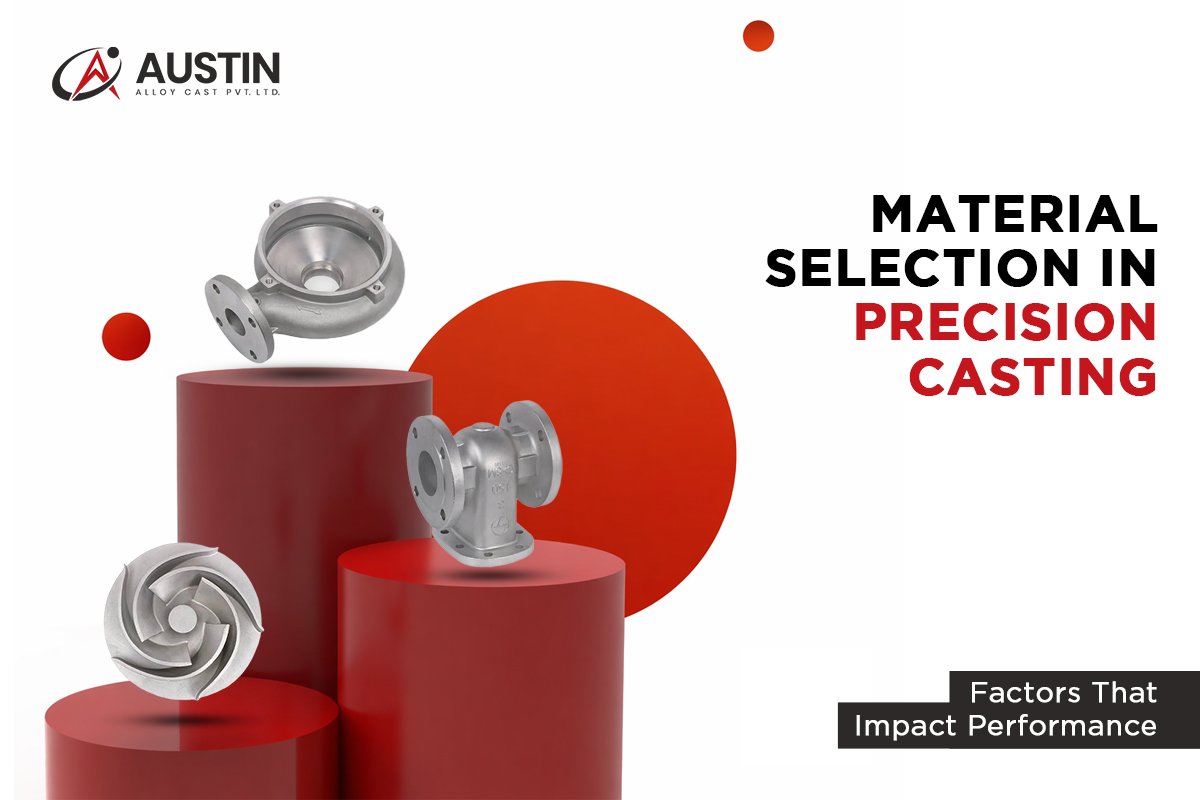
Material selection is one of the most influential decisions in precision (investment) casting, directly shaping how a component performs in service, how long it lasts, and how cost effective the final product is. At Austin Alloy Cast, we treat each alloy choice as a strategic design decision, not just a technical specification on a drawing.
In this article, we explore the key factors that impact performance when choosing materials for precision cast components.
Why material selection matters in precision casting
In precision casting, the alloy defines strength, corrosion resistance, dimensional stability, and service life under load and temperature. The wrong material can lead to premature wear, cracking, or corrosion, even if the part geometry and casting quality are excellent. On the other hand, the right alloy enhances reliability in demanding environments such as pumps, valves, and industrial machinery. At Austin Alloy Cast, we align material recommendations with the customer’s operating conditions, load requirements, and expected service life.
Key properties driving material choice
Several fundamental properties determine how an alloy will behave in a precision casting:
- Mechanical strength and toughness: High tensile and yield strength, combined with adequate toughness, are essential for components under cyclic or dynamic loads.
- Corrosion and oxidation resistance: We select stainless steels, nickel-based alloys, and cobalt-based superalloys when parts must withstand moisture, chemicals, or high-temperature oxidizing conditions.
- Thermal stability and creep resistance: For turbine blades, exhaust components, or high temperature fittings, alloys must retain strength and dimensional stability even at elevated temperatures.
- Wear and abrasion resistance: Components like pump impellers or valve trim benefit from alloys that resist erosion and surface degradation over long term operation.
By matching these properties to the application’s specific stresses, Austin Alloy Cast ensures that performance is optimized without over-specifying or overspending.
How process behavior affects material selection
The way a metal behaves during investment casting; its melt temperature, fluidity, shrinkage, and solidification pattern also influences material choice. Some alloys flow more easily into thin sections and complex geometries, reducing the risk of misruns or incomplete filling. Others shrink more during solidification, which can affect dimensional accuracy and require careful gating and pattern design. At Austin Alloy Cast, material recommendations are adjusted to align with the geometry, wall thickness, and critical dimension zones of the customer’s part.
Common alloys used in precision cast components
Different sectors typically lean toward specific alloy families:
- Stainless steels: Widely used for their combination of strength, corrosion resistance, and moderate cost in valves, pumps, and process equipment.
- Carbon steels: Offer high strength and toughness at lower cost, suitable for structural or mechanical components where corrosion exposure is controlled.
- Aluminium alloys: Provide lightweight, good strength to weight ratios, and excellent castability, making them popular for automotive parts.
- Nickel and cobalt base superalloys: Used where extreme temperature, corrosion, and stress resistance are required, such as turbine and compressor components.
- Titanium alloys: Chosen for high strength, light weight, and excellent corrosion resistance in medical applications.
Austin Alloy Cast evaluates where each of these families best fits the customer’s functional and economic targets, avoiding generic “one size fits all” material assignments.
Service environment and lifecycle considerations
The operating environment heavily influences material selection. Components exposed to saltwater, acidic chemicals, or high pressure steam demand alloys with superior corrosion resistance and, in some cases, biocompatibility. For parts in high cycle or high vibration environments, fatigue and creep resistant alloys are preferred. Austin Alloy Cast customizes material choices based on factors such as temperature ranges, media exposure, duty cycles, and expected service life, ensuring long term performance and reduced maintenance costs.
Balancing cost, lead time, and manufacturability
Material selection is never made in isolation from cost and production feasibility. Some high performance alloys are more expensive to source and process, which can affect overall project economics even if the technical fit is perfect. Fabrication, heat treatment, and post cast machining requirements also vary by alloy, influencing lead time and yield. At Austin Alloy Cast, material options are evaluated in terms of total cost of ownership balancing upfront material cost, processing complexity, and expected lifetime performance so customers receive the most practical, not just the most exotic, solution.
Partnering with Austin Alloy Cast for smarter material decisions
Choosing the right material for precision casting involves far more than reading a datasheet; it requires understanding the entire ecosystem of loads, environment, and lifecycle. By combining material science insight with decades of experience in investment casting, Austin Alloy Cast helps OEMs and industrial manufacturers select alloys that deliver optimal performance, reliability, and value. If you are designing or sourcing precision cast components, consider partnering early in the process to align material selection with both engineering requirements and real world production constraints.
To have a glimpse at our world class facility and products, visit us at www.austinalloycast.com.
For any queries or details contact us at info@austinalloycast.com.
Recent Posts