15 Oct 2026

BLOG
Designing Components for Investment Casting: 10 Mistakes OEMs Still Make
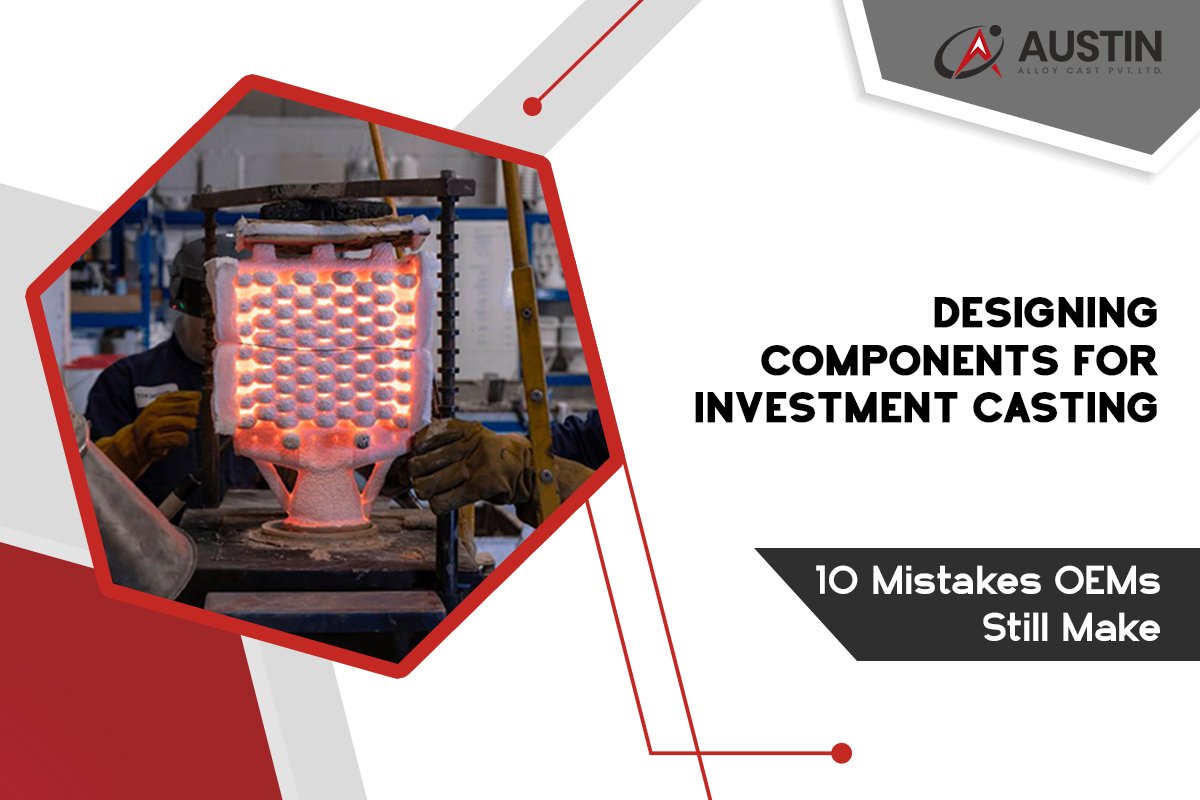
Investment casting is renowned for producing complex, high precision metal components with excellent surface finish and material integrity. Nevertheless, despite the many merits of this casting method, too many OEMs encounter avoidable problems in manufacturing. In most instances, the fault does not lie with the casting process itself, but with design decisions made prior to actual manufacturing.
Understanding and following proper investment casting design guidelines can go a long way in improving part quality, reducing lead time, and controlling better overall cost. Based on numerous real world project experiences, here are ten common casting design mistakes which OEMs are continuing to make and how they can be avoided.
1. Designing Without Considering the Casting Process
The most common errors are designing a part as if it is going to be machined or forged and then decide to investment cast it. Investment casting has unique strengths and limitations that must be taken into consideration at the design stage.
Ignoring these factors usually leads to unnecessary complication, higher scrap rates, and longer development cycles. Early involvement by an experienced foundry such as Austin Alloy Cast allows design adjustment to suit the casting process without compromising function.
2. Excessively Thick or Uneven Wall Sections
Investment casting can support very thin walls; however, a wall thickness that is too inconsistent leads to potential solidification issues and internal stresses that may cause porosity. Thick sections cool more slowly, while thin areas cool quicker, promoting defects.
These factors contribute to good metal flow and a uniform mechanical property. Whenever it is not possible to avoid wall thickness variation, gradual transitions should be used instead of abrupt changes.
3. Sharp Corners and Edges
One of the most common design oversights involves sharp internal and external corners. Such areas can have a stress concentrating effect and impede the smooth flow of metals in the casting process.
The use of fillets and radii enhances castability, part strength, and fatigue resistance of the component. Basic investment casting design recommendations for corner radii can greatly reduce rejection rates.
4. Unnecessary Tight Tolerances
OEMs generally specify extremely tight tolerances throughout the whole component where they are often not functionally required. This generally increases the complexity of inspection with greater cost and further secondary machining.
Smarter really is to apply tight tolerances only on critical functional surfaces. Clear communication between design engineers and casting suppliers helps in the definition of realistic, application driven tolerances.
5. Poor Feature Orientation
Features like holes, slots, and bosses have to be oriented in a manner that will facilitate the smooth flow of metals and strength to the shell. Improper orientation could lead to incomplete filling during casting or even distortion of the casting.
Only expert investment casting suppliers will be in a position to advise minor design modifications that will favour orientation without compromising the performance of the part. Early collaboration avoids corrections by trial and error later.
6. Draft and Parting Considerations Can Be Ignored
Although investment casting requires less draft than most casting methods, completely ignoring draft angles can still pose problems in pattern removal and shell integrity.
Designs that respect basic draft requirements reduce tooling issues and improve consistency. This aspect is usually overlooked by the OEMs due to unfamiliarity with practical aspects of the casting process.
7. Designing Internal Complex Cavities Without Feasibility Review
Investment casting supports complex internal features, but not all cavities are workable without cores or special techniques. When designs push these limits without feasibility checks, the result may be a high tooling cost or production risk.
A detailed design for casting review helps determine what is practical and cost effective. At Austin Alloy Cast, a feasibility analysis is a key step before finalizing the tooling.
8. Ignoring machining allowances
Another common design mistake in casting is not allowing ample material for critical surfaces to be machined. This can result in undersized features or rejected parts during finishing operations.
The proper machining allowances must be planned considering part size, material, and tolerance requirements of the component for maintaining consistency between casting and final component dimensions.
9. Application of Wrong Alloy
Selection of material often is given on a basis of availability or former applications rather than the proper service conditions. Unsuitable alloy selection could result in early failure, corrosion problems, or overengineering.
With investment casting, access is provided to a large range of alloys, including but not limited to stainless steels, duplex grades, and high performance alloys. Selecting the right material early in the process improves performance and lifecycle cost.
10. Not treating the foundry as a partner, but just as a vendor
Of all the mistakes that are made, perhaps the most forgotten involves bringing in the foundry too late in the design process. When suppliers are considered only as part producers, engineering input is wasted.
The collaborative approach enables geometry optimization, weight reduction, and improved manufacturability. OEMs using a collaborative approach with partners such as Austin Alloy Cast enjoy fewer revisions, faster approvals, and more reliable production.
Why Investment Casting Design Matters
Designing correctly for investment casting is not simply a matter of avoiding defects, it is about maximising the value of the process. Well designed components result in a better surface finish, reduced machining, improved mechanical properties, and lower overall cost.
By understanding common casting design mistakes, applying proven investment casting design guidelines allows OEMs to move from reactive problem solving to proactive engineering success.
Conclusion
Investment casting is a powerful manufacturing process, but its full potential is realized only when components are designed with the process in mind. Many of the challenges faced by OEMs can be traced to early design decisions that ignore the realities of casting.
With proper guidance and collaboration upfront, these errors can be completely avoided. Austin Alloy Cast treats design support as a vital part of the manufacturing journey, ensuring the business partner gets reliable, high quality components from the first production run.
Smart design begets better castings and better outcomes for OEMs.
To have a glimpse at our world class facility and products, visit us at www.austinalloycast.com.
For any queries or details contact us at info@austinalloycast.com.
Recent Posts