15 Oct 2026

BLOG
From Sand Casting to Machining: End-to-End Solutions for Industrial Equipment
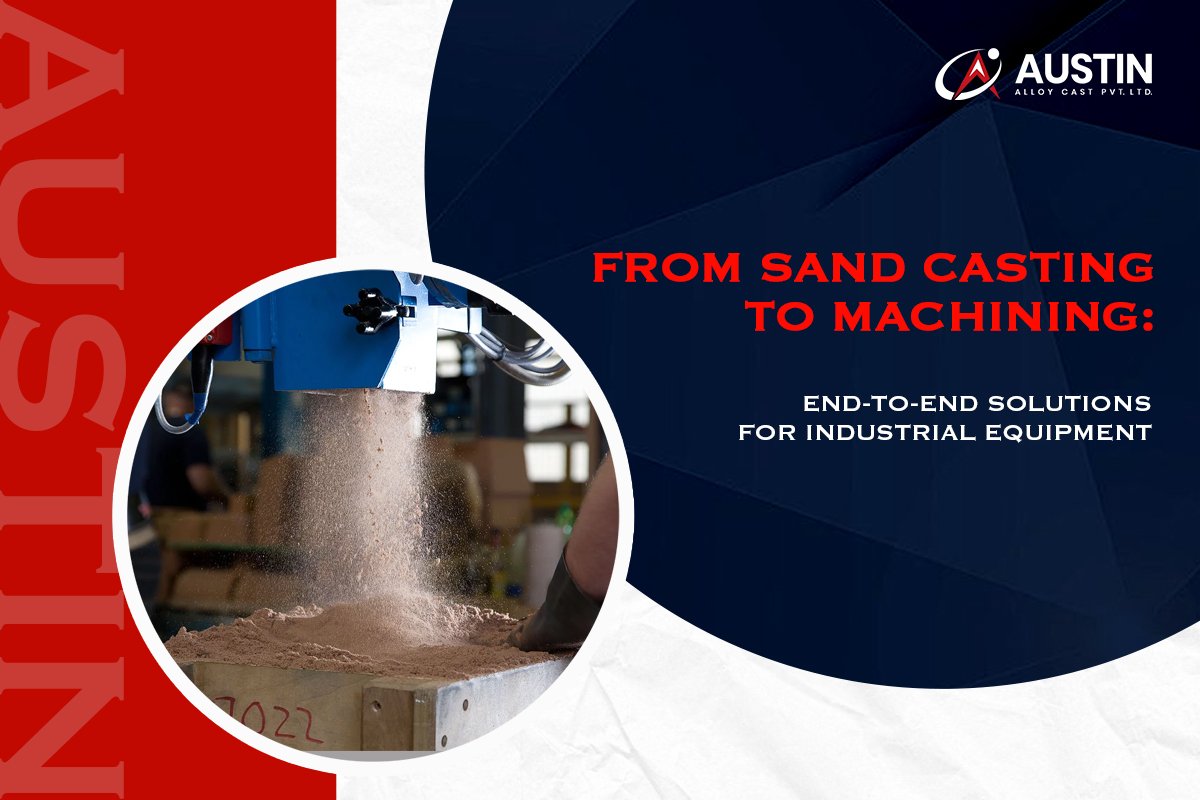
In the Industrial Machinery sector, system manufacturers are faced with challenges of strict lead times, high quality expectations and increasing cost competition. To achieve all of these objectives, many manufacturers will have to rely on multiple suppliers throughout the supply chain creating a situation in which the potential for delays, inconsistent quality and increased complexity in project management exist. It is at this crossroad where an integrated “casting to machining” approach provides value.
The production process for the sand casting to a fully machined assembly ready part is a well managed and quality driven process. The entire production process is established to allow for an integrated process from start to finish in order to provide uniformity, efficiency and cost savings to OEMs across multiple industries.
Sand Casting is the foundation for large and complex Industrial Components.
Sand Casting remains one of the most versatile and cost effective ways to fabricate large and geometrically complex components. The versatility of sand casting allows manufacturers to make patterns, large sections, and parts which would be too expensive if manufactured with traditional methods i.e. metal forming.
In many industries, such as Construction Machinery, Pumps, Industrial Valves, Mining Equipment and Heavy Engineered Equipment, Sand Casting provides the combination of functionality, scalability and cost effectiveness. Whether creating a prototype or producing large quantities, Sand Casting provides the flexibility to meet the varied needs of all the other industries that utilize the many benefits of Sand Casting.
In House Pattern Making & Moulding
The beginning of the process to achieve / ensure consistency for castings is prior to introducing the molten metal into the process, by way of managing to control the dimensional accuracy and quality of the casting models (internal tooling or patterns), control the dimensional shrinkage tolerance, the gating or flow configuration of the molten metal into the mould, assembly of pattern / core and the process to reproduce the pattern.
- For custom model creation, there is the use of both CNC machined pattern, allowing for increased dimensional preciseness of the finished casting.
- Through regulated methods of moulding, we ensure, achieve and maintain the required compaction of the sand, suitable sand characteristics, and maximum mould flow properties.
- The establishment of feedback loops between Engineering and Pattern Making, and Engineering and Casting helps to avoid errors during manufacturing.
By completing (or consolidating) the control of these processes internally, we drastically reduce the dimensional variations of the finished product, thus providing greater efficiencies in the machining processes for finished parts.
Heat Treatment: Enhancing Mechanical Properties
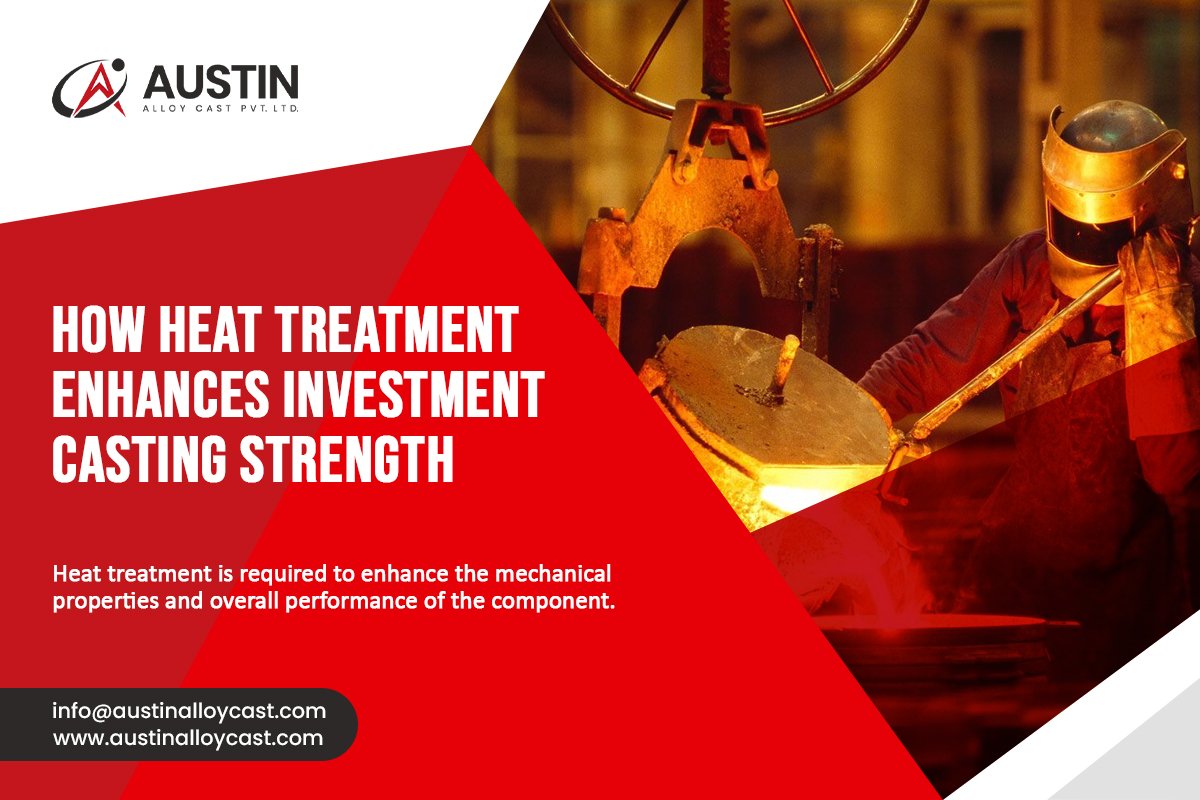
The heat treatment process converts the cast item from an unrefined or unprocessed state into a useable engineering component. The process improves the physical of the item’s material characteristics and stabilizes the metal’s microstructure for the required protection for long term service.
Depending upon the alloy type and intended use, the heat treatment process generally consist of:
- Normalizing the metal, to refine and fully uniform the metal’s grain.
- Stress Relieving, to remove residual stress created during the initial casting.
- Quench and temper to add tensile strength, hardness, and toughness to the item.
- Solution heat treating for specialty alloys.
All heat treatment cycles are monitored closely to maintain the desired metallurgical property results required for castings manufactured for use in demanding industrial applications.
Precision Machining: Transformation of Cast Shapes
The finished part process transforming a casting into a precision engineered component is where true machining capability and expertise come to the fore. With Metflow Cast, a modern foundry equipped with an in house machine shop, this capability is reinforced by advanced machining infrastructure that includes vertical and horizontal machining centers, vertical turning lathes, CNC turning centers, and hydraulic tapping machines to handle a range of sizes and complexities with high accuracy. Machining procedures typically include:
- Rough Machining – Removal of excess material and establishment of reference surfaces.
- Finish Machining – The process of creating tight tolerances, smooth surfaces and exact dimensional specifications.
- CNC Operations – The ability to produce complex contours and multiple axes.
Manufacturers that engage in both casting and machining processes at one facility can be assured that their casting tolerances, fixture setups, and machining processes will be in alignment, resulting in improved quality and reduced lead time for finished components.
Testing and Inspection: Quality Control at All Times
Quality control is incorporated into every aspect of manufacturing. Each part undergoes a series of tests and inspections to ensure that it meets customer specifications for reliability, lifespan and performance.
Some common inspections include:
- Dimensional inspection
- Visual inspection for surface condition
- Non-destructive testing like Magnetic Particle Inspection, Ultrasonic Testing, or Radiography as required, based on part’s critical nature.
- Verification of mechanical properties after heat treatment
- Final inspection of dimensions and surface finish.
The combination of the inspection criteria and method used guarantees a defect free functional component.
The Importance of an End to End Solution for Industrial OEM’s
Industrial OEMs around the world are becoming manufacturers’ partners for many reasons. The combination of foundry, machining from a Single Source Offers the following:
- Shorter lead times through reduced handoffs and production interruptions
- Increased quality consistency through unified process control
- Lesser reliance on multiple Vendors and the increased difficulty of coordinating
- Optimized cost structure through a Single Ecosystem incorporating casting, heat treatment and machining
- Accelerated product development cycle with coordinated design and engineering teams
In markets where rapid response is critical and reliability is paramount; these advantages directly correlate to greater operational efficiency and increased customer satisfaction.
Conclusion
The transition from sand cast to machined parts is not just an assembly line process; rather, it is intimately tied to the overall functionality of industrial machinery. With Metflow Cast which is the sister’s company of Austin Alloy Cast, customers can be assured that components are manufactured strictly to specifications, incorporating all the critical attributes required for strength, durability, and direct installation readiness.
By combining the processes of casting, heat treating, machining and inspection into one solution for industrial OEM, we deliver an economically viable, high quality and dependable manufacturing environment that reduces risk, accelerates the project schedule and improves performance for every product.
To have a glimpse at our world class facility and products, visit us at www.austinalloycast.com.
For any queries or details contact us at info@austinalloycast.com.
Recent Posts